
Unfolding Innovation
Folding art into engineering, Larissa Novelino uses origami to shape smarter, safer structures.

By Alex Becker
For Larissa Novelino, innovation often begins with a single crease. An assistant professor of civil and environmental engineering at Rice, Novelino has built her research on a surprising foundation: the centuries-old Japanese art of paper folding. In her lab, origami isn’t about cranes and swans, it’s about transforming how we design buildings, materials and machines.
“I was never the crafty, artistic type,” she says. “My mom still can’t believe I ended up working with origami.”
Origami engineering applies the geometric principles of folding to real-world challenges, creating structures that are compact when stored but strong and functional when deployed. Novelino’s designs range from portable emergency shelters to lightweight materials with unique mechanical properties.
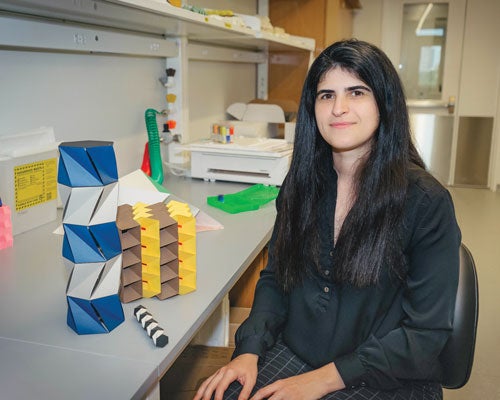
“Through geometry, you can design how a material behaves — its stiffness, weight, even how it responds in different directions,” she explains. “You can make something deployable in one direction, then stiff and load-bearing in another.”
Growing up in Belém, Brazil, Novelino always excelled at math, but her path to origami engineering began almost by accident. While pursuing her master’s in structural engineering, she connected with a professor studying origami-inspired design. “It was nice to take a break from the computer and actually make things,” she recalls. “It’s still math and mechanics, but with this whole new layer of understanding.”
Her ultimate goal is to reimagine construction itself. “If we can design structures that fold flat, transport easily and deploy with minimal human risk, we can make job sites safer,” she says. “That’s not just innovation for the sake of novelty; that’s innovation that protects lives.”
Novelino’s research extends well beyond construction. She has collaborated on origami-inspired electromagnetic filters that shift operational frequencies simply by changing shape, and on soft robots that “snap” into new positions to perform different tasks. For Novelino, the tactile nature of folding connects imagination and engineering.
“You can prototype with paper, test ideas by hand, then scale them up with advanced materials,” she says. “It’s a tangible way to understand concepts that can feel abstract on a computer screen.”
That hands-on spirit also defines her classroom. At Rice, students in Novelino’s courses don’t just solve equations — they fold them. “They’re always surprised by how much a single sheet of paper can teach them about geometry, mechanics and design,” she says.
From the Winter 2026 issue of Rice Magazine