
Syllabus: “Black Mirror” and Philosophy
Is your conscience in the cloud? A first-year writing seminar examines philosophical questions through the dystopian lens of the Netflix anthology series.
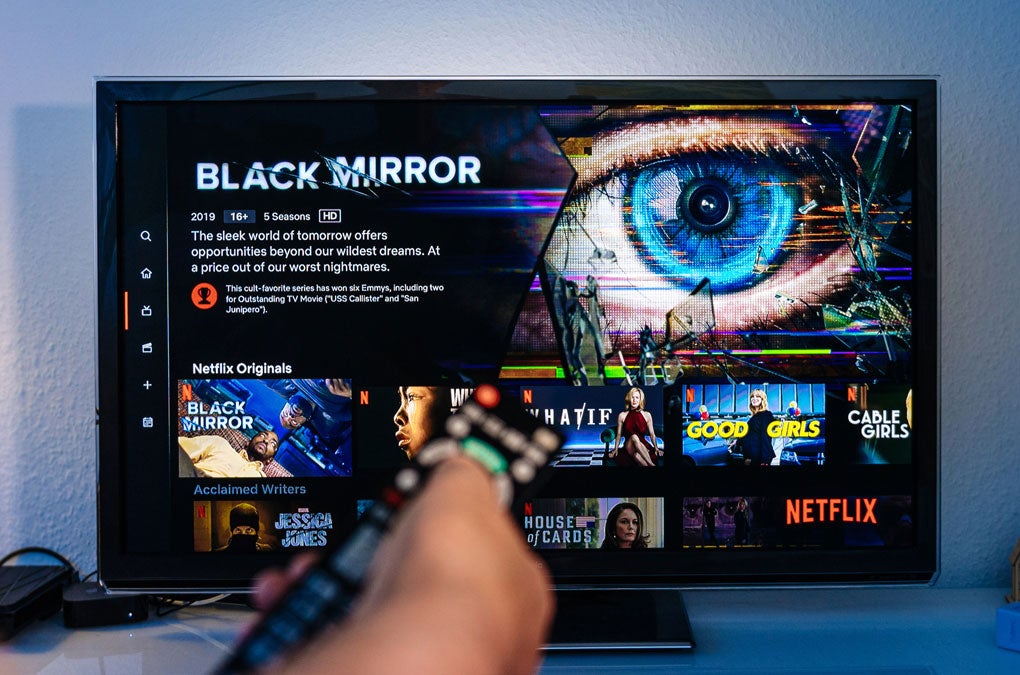
By Andrew Bell
FWIS 126
Black Mirror and Philosophy
DEPARTMENT
First-Year Writing Intensive Seminars
DESCRIPTION
This course examines key philosophical questions through the lens of “Black Mirror,” the Netflix anthology series that explores the dark intersections of technology and human nature. Pairing episodes with classic philosophical texts, students wrestle with questions of consciousness, morality and what it means to be human in an age of intelligent machines.
In a recent discussion of the “Black Mirror” episode “White Christmas,” first-year students debated whether a digital “cookie” — a simulated copy of a person’s mind — can truly possess consciousness or moral responsibility. The conversation, led by Daniel Pinto Talero, a doctoral candidate in philosophy, connected the episode’s haunting theme to philosopher John Searle’s “Chinese Room” experiment, which challenges the idea that artificial intelligence can genuinely understand rather than merely imitate.
Can a digital replica of a person authentically mimic a real human mind? What moral obligations do we have toward sentient-seeming systems — and what happens when they suffer? Students tackled questions like these in a lively roundtable, examining the line between simulation and duplication and the ethical implications of exploiting digital consciousness for human ends.
For first-year biosciences major Claire Kevil, the class was an eye-opening entry into philosophy.
“I’ve been a big fan of ‘Black Mirror’ for a long time, and I find it very applicable to today’s society,” Kevil says. “Even though a lot of the concepts are dystopian, all of the episodes have something you can take from them. … I’d never taken a philosophy class before, so I was really interested to see how the show’s moral lessons tie into known philosophical concepts.”
Class discussions are a highlight, Kevil says, as the breadth of student viewpoints produces enlightening conversations.
“Everyone comes in with so many different perspectives, and I find that fascinating because a lot of what people say I never would have thought of,” she says.
Beyond lively debate, the course also strengthens students’ skills in critical reasoning and ethical analysis.
“Our writings are logical analysis papers, so we’ve learned how to formulate an argument — how premises follow conclusions, how to make a valid argument without being circular,” Kevil says. “It’s challenged me to think about how to disprove statements and how to look at things from a more open, unbiased perspective.”
From the Winter 2026 issue of Rice Magazine