
State of the Arts
The opening of the Susan and Fayez Sarofim Hall brings light-filled studios, architectural acumen, a state-of-the-art theater and a defining moment for the arts at Rice.
By Sarah Rufca Nielsen
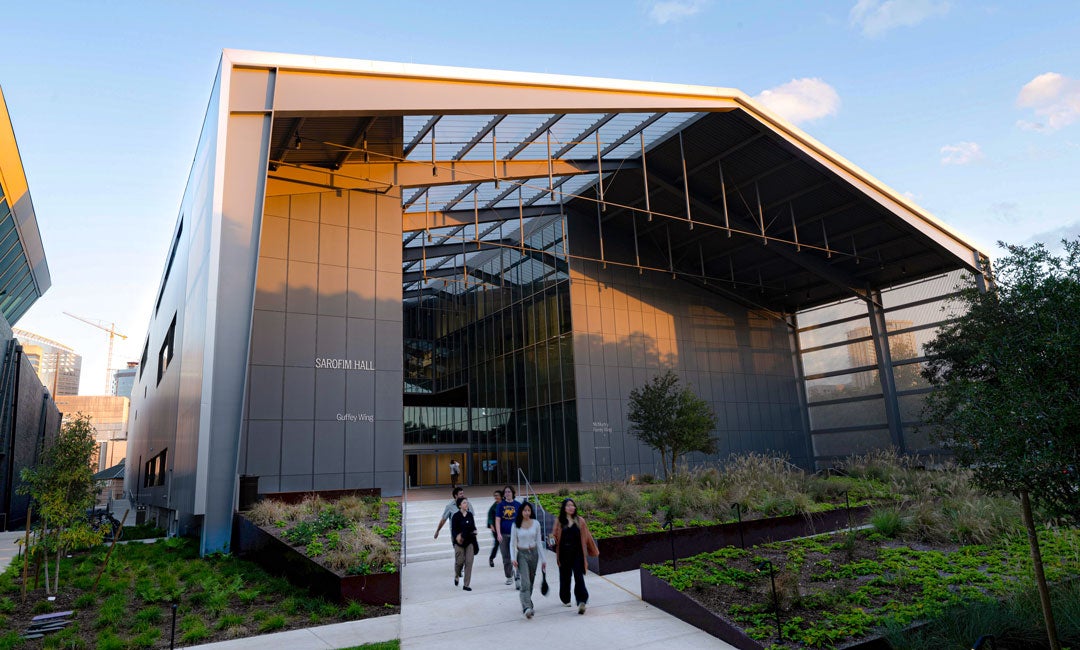
With a glow made from sunlight slicing through glass and steel beams stretching toward the sky, the new Susan and Fayez Sarofim Hall gleams at the edge of campus like an idea made visible. From the very elements of its design — this meeting of openness and structure — the new home for Rice’s Department of Art offers a metaphor for the university’s approach to arts education: prizing experimentation but grounding it in discipline; welcoming collaboration without blurring individuality.
For Dean Kathleen Canning, Sarofim Hall and the school’s new name are two parts of the same story: Rice embracing the arts as both discipline and engine of discovery. “When I first arrived, I used to say, ‘The arts are at the heart of the humanities,’ but that felt vague,” she says. “Renaming it the School of Humanities and Arts acknowledges the arts’ power.”
“Symbolically, it’s huge,” agrees John Sparagana, chair of the Department of Art. “It acknowledges how the arts enrich the humanities and vice versa. Contemporary artists draw on philosophy, religious studies, creative writing and beyond. Dean Canning understood that synergy from the start.”
Architecture as Aspiration
Sarofim Hall’s story began not with a single design sketch but with a question: What kind of space does a modern art department need to flourish?
Shortly after arriving in 2018, Canning initiated an external review of the school, its programs and its facilities. With regard to the art department, the panel’s report was blunt in its clarity. “They said, essentially: ‘You have a treasure in a trash can,’” Canning recalls. “Incredible faculty and students, but awful facilities. They made Rice confront the question: Does it truly want the arts?”
For decades, Rice’s art program thrived on imagination and perseverance, though its identity was often in flux. It was just over two decades ago that the discipline split from the study of art history to become the Department of Visual and Dramatic Arts. Then, in 2024, the department morphed again, decoupling from theater to become, simply, the Department of Art. With its identity fully defined, all that the art program lacked was a space that matched its ambition. “Sewall Hall is historic, but the facilities just couldn’t support what we do,” Sparagana says.
The Future Takes Shape
“When I was told in 2019 that there would be a new art building, I could hardly believe it,” Canning says. Sarofim Hall began as a $25 million building proposal, based on initial estimates of a 50,000-square-foot structure. However, as plans developed, the scale of both the building and the cost grew substantially. Committed to the vision of a structure that would be both a marquee building on campus, as well as a space that would meet all the long-term needs of the department, Rice eventually invested $76 million into Sarofim’s 94,000 square feet of glass and concrete precision.
An international design competition ultimately selected alumnus Charles Renfro ’87, ’89, partner at renowned firm Diller Scofidio + Renfro. “Charles Renfro’s design stood out: intimate, interdisciplinary, beautifully functional,” says Canning. “As a Rice alum who studied art and architecture here, he truly understood what was needed.”
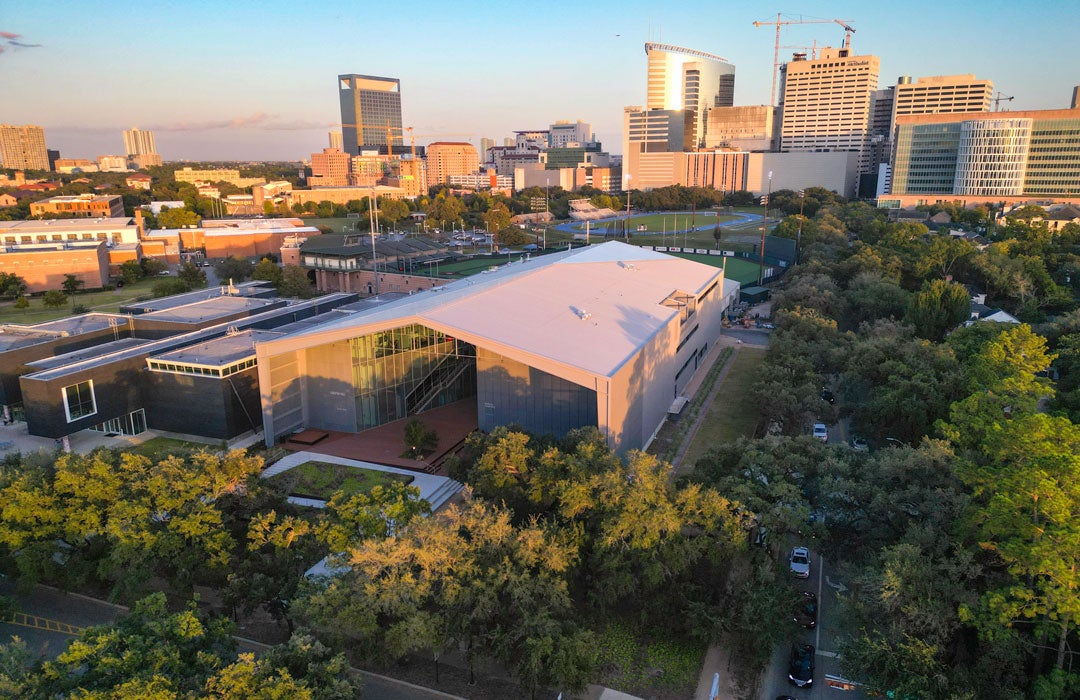
The building’s shed-like form, for example, echoes the Art Barn that previously occupied the same location and function, established by noted Houston art patrons John and Dominique de Menil in the 1960s. “It’s a nod to the Art Barn’s history while dramatically expanding its scale and capability,” notes Sparagana.
The building’s distinctive V-shape is equally intentional. One arm houses public spaces — a cinema, gallery space and performance areas — while the other consists primarily of studios and other workspaces. Where the two wings meet, there’s a central open space for informal collaboration and critiques that Renfro calls “the kiss.” Both beautiful and practical, the building’s striking form allows light to flow freely into glass-lined studios.
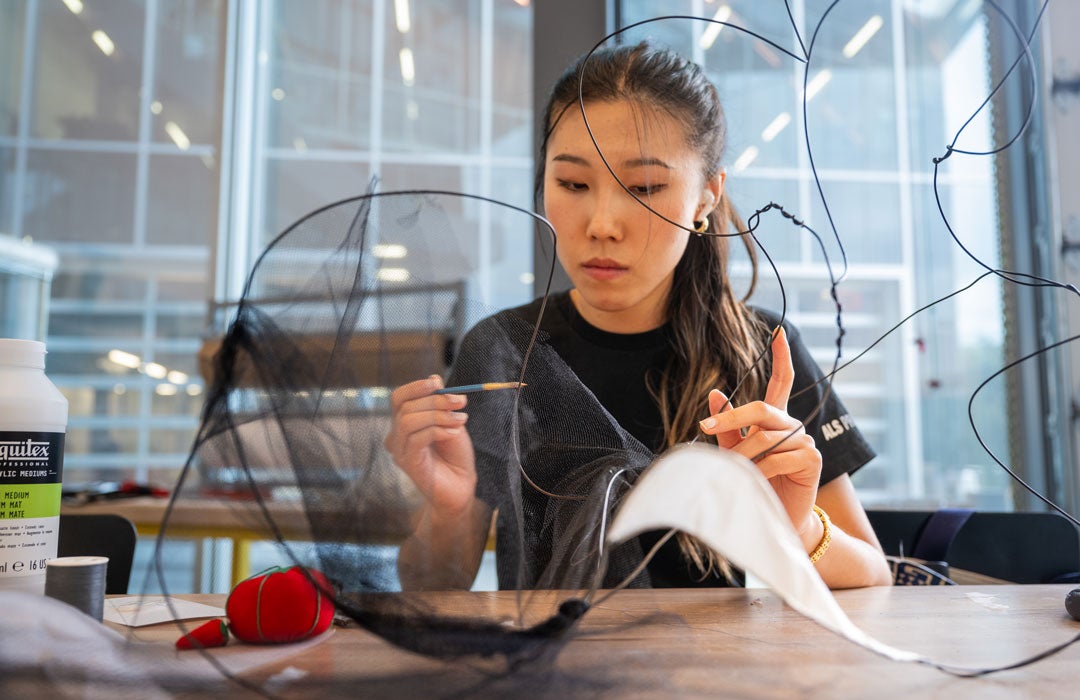
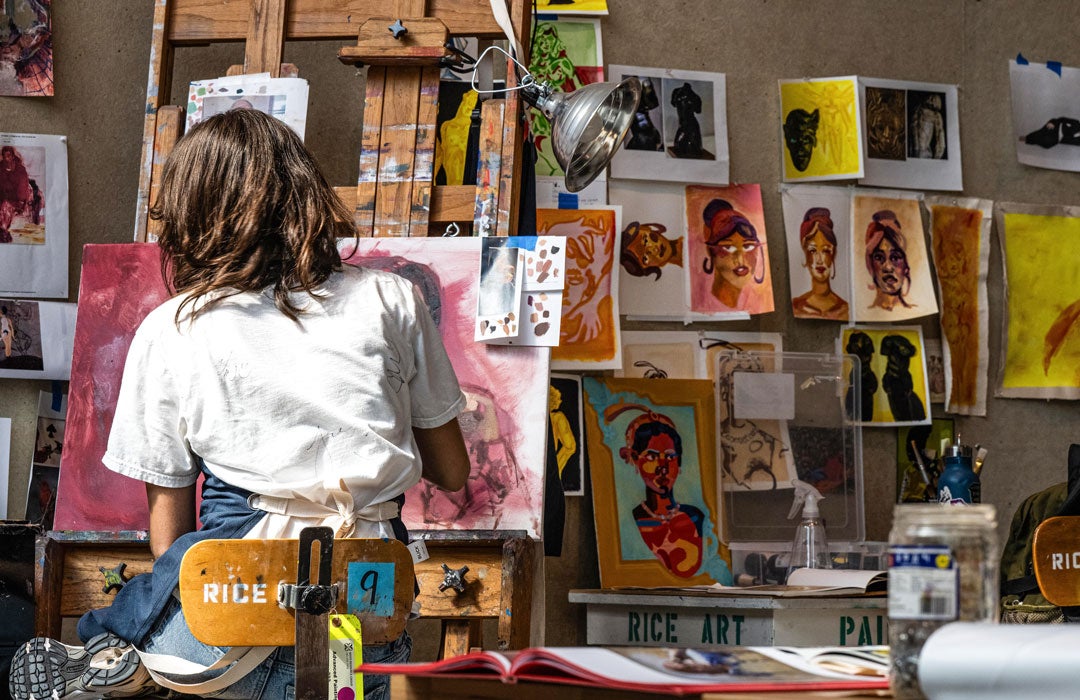
On the third floor, painting and drawing studios are connected via movable, barn-style doors designed to offer the department maximum flexibility — one giant studio or three separate ones. “Contemporary art today thrives on permeability — painting, sculpture, video and performance interacting with one another,” says Sparagana. “Sarofim was intentionally designed to encourage that.”
A Continuum of Creativity
What began as a building project has become something larger — a statement about the place of art in the life of a world-class research university. The light that fills Sarofim Hall is more than an architectural flourish. It’s a reminder that creativity, like sunlight, is a form of energy — one that illuminates everything it touches.
“Half the students in art [courses] are actually science or engineering majors,” Canning notes. “It’s our second-largest major after English. The demand is huge.”
She attributes that appeal to a generation that thinks visually. “Students today are deeply visual. They think in images, design and media in ways previous generations didn’t. Taking an art or photo course helps them understand visual culture, interpretation and representation — skills that matter in any field.”
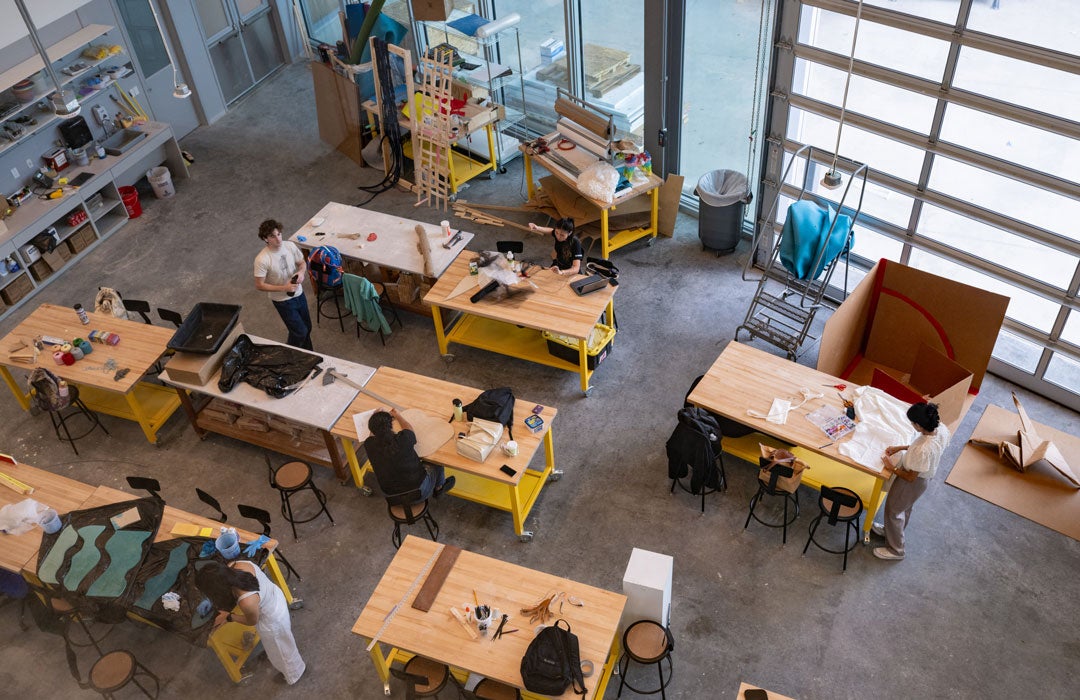
Now, the program is expanding in scope as well as visibility. The art department has added new faculty and restructured its curriculum to reflect a broader, more contemporary vision of artistic practice. “We’re retooling our curriculum so that graduates — whether they go into tech, grad school or other fields — leave with a sophisticated understanding of art practice. We’re aiming for impact and relevance, not just within art but in the world beyond it,” Sparagana says.
At a moment when many universities are scaling back their investment in the humanities, Sparagana calls Rice’s investment in the program enlightened. “There’s a part of the arts that’s very much about critical thinking. There’s a part of the arts that’s very much about consciousness — you know, what it is to be human in a very deep, expansive state. When I say it’s an enlightened decision by the university, I mean truly bringing this very necessary light to the world that we’re in.”
When Canning reflects on this moment, she doesn’t describe a revolution but a realization — a recognition that the visual arts are integral to Rice’s intellectual landscape. “The arts at Rice will continue to expand because of student demand, incredible faculty and institutional support,” she says. “There’s a dynamism now that must be nurtured — strategically, thoughtfully. The arts aren’t going anywhere. They’re central to Rice’s identity now.”
From the Winter 2026 issue of Rice Magazine