
Space Germs!
How junior Ankhi Banerjee helped NASA scientists monitor microbes on the International Space Station.
By Silvia Cernea Clark
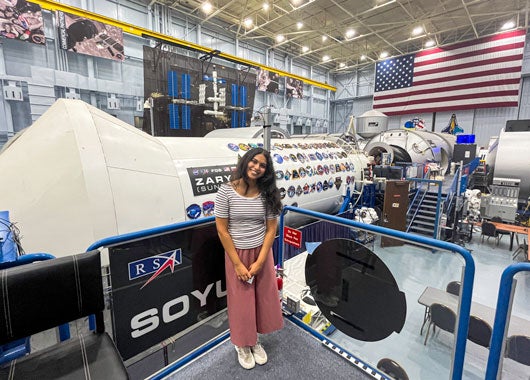
Every time astronauts blast off into orbit, so do countless microorganisms that quietly colonize spacecraft surfaces and living spaces. As the next era of space exploration takes shape, keeping track of those invisible stowaways is vital for astronaut health and spacecraft safety. This past summer, one Rice undergraduate helped NASA scientists build a new way to do just that.
Ankhi Banerjee, a junior double majoring in computer science and biology, spent 10 weeks at NASA’s Johnson Space Center creating a data-analysis pipeline to track microbes aboard the International Space Station. Working with NASA microbiologist Sarah Wallace and her team, Banerjee developed visualizations showing how different bacteria are distributed across the ISS and began designing an anomaly-detection tool to flag unusual microbial signatures.
“The patterns told everyday stories about life in orbit,” she says. “Sweat-loving bacteria clustered around gym equipment, food-associated microbes turned up near dining areas, and bathroom handrails proved to be microbial hot spots.”
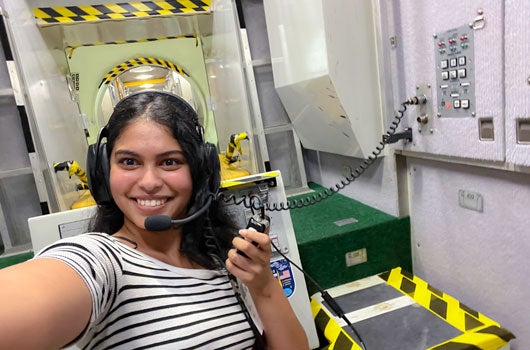
Banerjee’s project grew out of Genome Sleuths, a Rice research program led by computer scientist Todd Treangen that engages undergraduates in developing computational tools for studying microbial genomes and metagenomes. The program is part of Rice’s Vertically Integrated Projects initiative, coordinated through the Office of Undergraduate Research and Inquiry, which embeds students in faculty-led research for multiple semesters to build deeper skills and leadership.
Treangen called Banerjee’s work one of Genome Sleuths’ standout projects. “Ankhi developed software that impressed a full team of NASA scientists, and she’s just getting started,” he says.
At the end of the program, Banerjee presented her work at Johnson Space Center. “I thought it would be a small group I already knew,” she recalls. “Then I walked in and there were around 30 people. It was intimidating, but everyone was so kind — they just wanted me to learn.”
For Wallace, the collaboration underscores the value of Rice-NASA partnerships. “I was blown away by [Ankhi’s] enthusiasm, intellect and ability to continually ask the right questions,” she says. “Her tool is something that we have long sought, and I look forward to its use to enhance crew health and safety.”
From the Winter 2026 issue of Rice Magazine