
The Rice duo reimagining Virgil’s Aeneid
A seven-year collaboration between Scott McGill and Susannah Wright ’18 has culminated in a new blank-verse translation of the epic poem.
By Tracey Rhoades
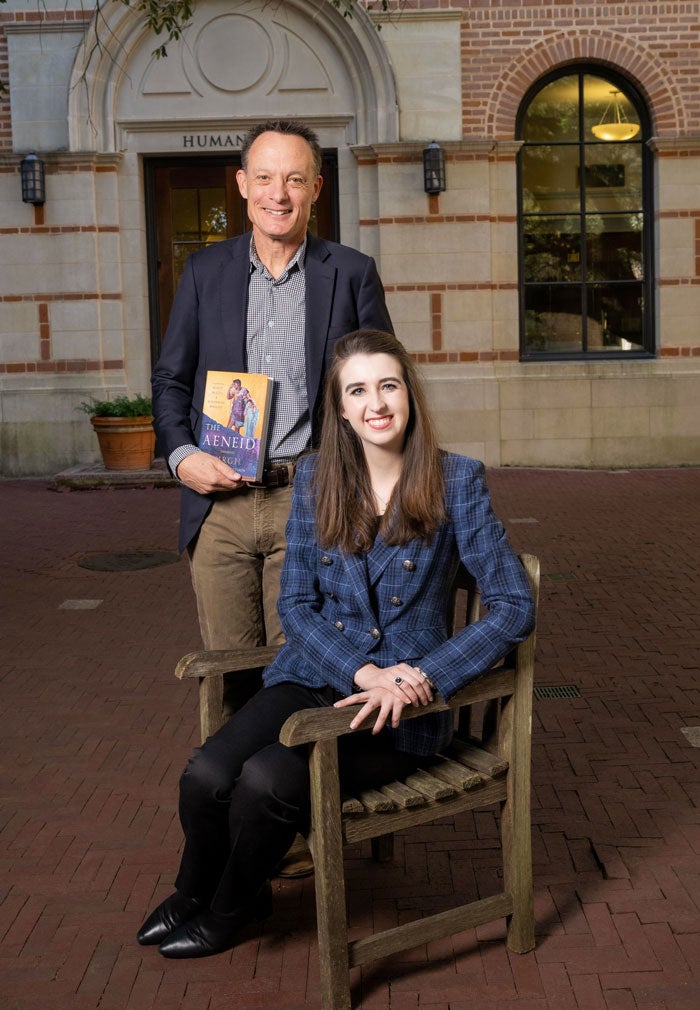
A seven-year literary odyssey has finally come to fruition for Rice professors Scott McGill and Susannah Wright ’18 with the release of their translation of Virgil’s “The Aeneid.” The project originated when Wright was a Rice undergraduate, translating lines as part of her senior thesis with McGill as her adviser. They discovered a shared love for Virgil’s Latin epic and decided to continue working on the translation despite Wright’s departure to Harvard, where she earned a doctorate in classical philology in 2024. Collaborating digitally from across the country, the duo spent countless hours going through the poem’s 10,000 lines to produce its first collaborative English translation.
What was the most inspiring part about the work and completion of the translation?
Though we have read the poem so many times as students and professors, the translation gave us a chance to read its nearly 10,000 lines more closely than we ever have — literally beat by beat, without skipping a single syllable — and thus to see things that we hadn’t before. It was especially inspiring to work through the text in this way, side by side, in constant dialogue both with each other and with Virgil himself.
Conversely, what was the worst part?
Translating a monumental epic work like “The Aeneid” is a formidable task, and there were certainly moments, and even hours, of despair along the way (any author will know what we’re talking about). We chose to translate the poem into unrhymed iambic pentameter, or blank verse, which imposed particular demands. For instance, in a metrical translation, recognizing that even a single word is not quite right sometimes requires revising entire lines and even passages to accommodate the rhythmic pattern of the verse. Figurative language, such as metaphors, can also be very difficult to translate across languages. But even at the most challenging moments, it was deeply reassuring to be working together and to support one another as we moved ahead on our own epic journey through the poem.
What was your favorite passage or passages to translate?
Scott McGill: In Book Two, Venus, Aeneas’ divine mother, comes to tell him that he must leave the falling Troy and begin his journey to Italy. To convince him, she removes the mortal veil or scrim from his eyes and allows him to see reality as it actually is: Aeneas watches as gods hostile to the Trojans destroy the city, tearing it up from its foundations and supporting its enemies as they raze it. It’s an absolutely chilling scene. The drama of it, and the way it depicts mankind as subject to overwhelming divine forces, hits me to the core. To convey the terror and power of the passage was a really stimulating challenge: it’s a vivid example of what Virgil demands of his translators throughout the poem.
Susannah Wright: Many of my favorite passages to translate were in Book Six, when Aeneas makes a harrowing journey into the Underworld. While there, he sees famous figures from mythology and Roman history, and he also has powerful encounters with people he had known closely in his own life, including the Carthaginian queen Dido (with whom he has a tragic love affair in Book Four) and his father, Anchises. Trying to capture both the emotional weight of those scenes and the shadowy, dreamlike quality that pervades so much of Virgil’s Underworld was both challenging and deeply gratifying.
What has the response been thus far?
We feel very fortunate that the book has been received enthusiastically by audiences at a series of events at bookstores and universities this past summer and fall. We were able to hold readings in different parts of Texas and the East Coast shortly after its publication in August, as well as to have events with Emily Wilson [who wrote the introduction] at the Free Library of Philadelphia and the 92nd Street Y in New York. The response from the readers has been thrilling for us, with full-house audiences and engaged, thoughtful questions at every stop. The experience of sharing the translation for audiences has also been a bit surreal, since the project lived for so long just between our two computers!
Do you think translations like this could be a better, more accessible, user-friendly way for school-aged students to study the classics?
One of our major aims with the translation has been to capture the power of Virgil’s poetry in accessible, immediate language that can convey its emotional urgency to modern readers of all ages. Here at Rice, as at many other institutions, several of our Classics courses are taught with readings in English. We wanted our translation to bring the poem to life for students while also meeting the needs of teachers, so we asked ourselves what supporting materials we would want to find in the book when teaching the epic. To make the translation as reader-friendly as possible, we included extensive resources: a comprehensive glossary, notes on the translation, genealogies and maps.
How important is humanities research to undertaking and completing a project like this?
Humanities research was integral to this project from start to finish. Every act of translation is an act of interpretation, and so every beat and every line of the poem required us to engage deeply with the meaning of the poem, and with the many centuries of scholarship on it. We should say, too, that the translation had its origins in an undergraduate research project at Rice: its earliest lines were developed as part of Susannah’s senior thesis, advised by Scott. We are confident that this is the only translation of the poem with such an origin story. Rice is the ideal place for such collaboration: our size facilitates close mentorship ties between students and faculty, and our commitment to supporting undergraduate research gives students the chance to pursue work not just under the guidance of, but even in partnership with their professors. In fact, we have been working together since Susannah was a Rice freshman and a Century Scholar, which facilitated our collaboration on a separate project that exposed us both to the challenges and delights of verse translation for the first time. After more than a decade, our enthusiasm for collaborating has only grown. Now that Susannah has returned to Rice as a professor, we look forward to taking on future projects as colleagues in the same spirit of open collaboration that has defined our work so far.
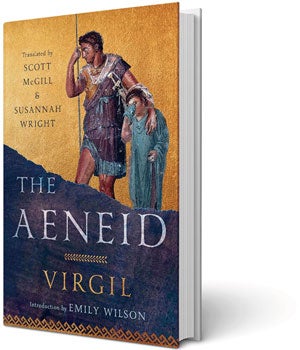
The Aeneid, by Virgil, translated by Scott McGill and Susannah Wright
Published by Liveright, 2025
From the Winter 2026 issue of Rice Magazine