
Restoring Hope, Reef by Reef
Rice alum Rusty Ludwigsen spent a year diving into the science and politics of marine habitat restoration.
By Scott Pett ’22
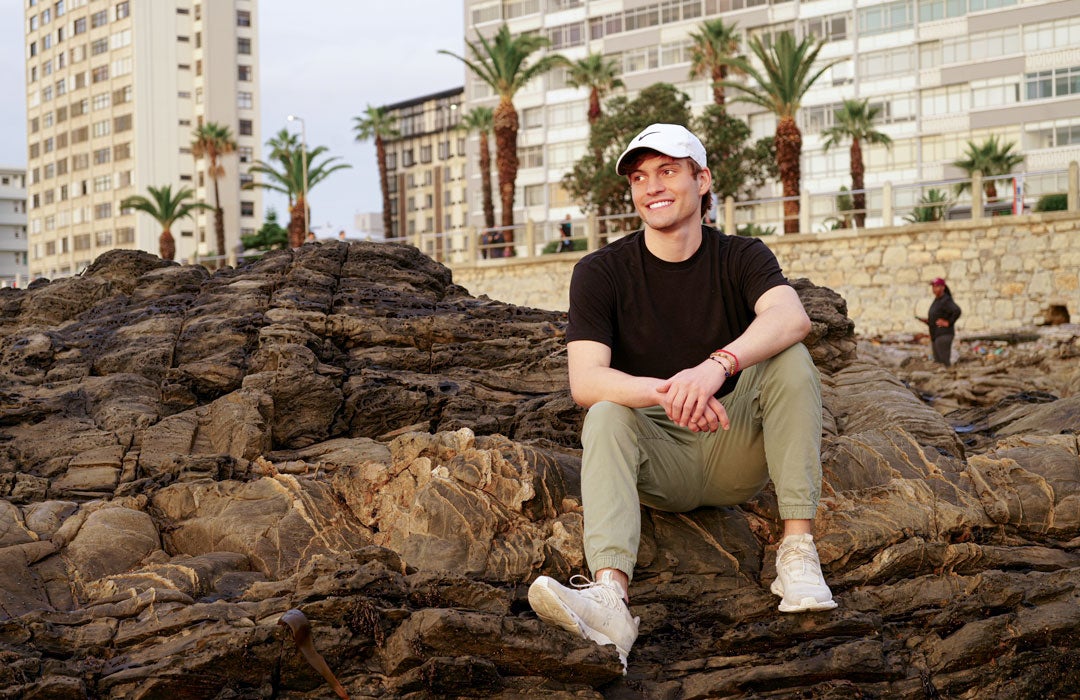
Over the past year, Rusty Ludwigsen ’23 swam through seagrass meadows in Greece, built coral nurseries off the coast of Indonesia and dodged sharks in the kelp forests of South Africa. His travels are part of a self-designed research project that asks a deceptively simple question: Can we restore what’s been broken?
Made possible through the Roy and Hazel Zeff Memorial Fellowship — funded by Rice’s Keith Anderson Professor of Accounting Stephen Zeff and run by the Center for Civic Leadership — Ludwigsen traversed five continents to study efforts to restore damaged and diseased marine ecosystems. Modeled after the national Watson Fellowship, the Zeff supports one graduating Rice student each year in pursuing a yearlong international project. The experience fosters personal growth as much as academic inquiry, and fellows must travel to places they’ve never been.
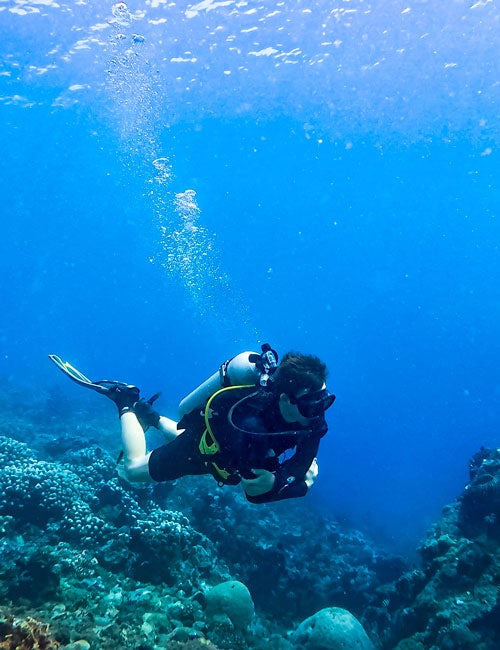
Ludwigsen’s journey brought him face to face with the world’s most important and vulnerable coastal ecosystems, including Australia’s Great Barrier Reef — and he learned that even well-intentioned restoration has its limits. “Marine restoration efforts are essential,” Ludwigsen says. “But until we fix the systems that are causing damage, it’s like trying to fix a sinking ship without plugging the hole.”
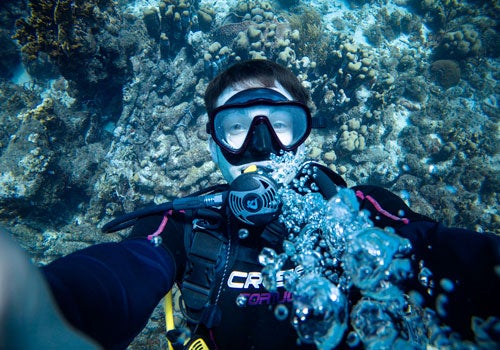
He began in Curaçao, learning to scuba dive — an essential skill for what lay ahead. There, he partnered with a nonprofit working to reestablish coral populations devastated by disease. “They’ve managed to regrow entire staghorn and elkhorn corals once nearly wiped out in the region,” he says. The effort has shown promising results: low bleaching, healthy regrowth and even coral spawning. “It was really encouraging to see,” says Ludwigsen, “especially because it’s so community driven.”
From there, Ludwigsen went to Indonesia, spending months with a nonprofit field school on the volcanic island of Lombok, where he spent nearly every day scuba diving to help grow coral, build artificial reefs and perform his own experiment. The biodiversity was staggering — “an alien world under the surface,” he says — but so was the scale of destruction. He saw firsthand the effects of blast fishing, plastic pollution and coastal runoff and learned how economic pressures make sustainable practices difficult.
“It can feel like a very small drop in the bucket,” he says. “People are doing what they can, but what we really need is long-term investment and policy support.” Many nonprofits, he adds, are pressured to focus on quick, visible wins to justify funding — even when those wins aren’t best for the area long term.
Even so, the global experience has been transformative. It exposed him to the complexities of marine restoration, but more importantly, it gave him a rare sense of agency. He designed the project himself, coordinating every detail. For the first time, he says, he’s been an independent researcher — not just observing the work but shaping it.
“Some days are discouraging, seeing how big the challenges are,” he says. “But I’ve learned a lot about myself this year and seen how much people are doing to improve the world — even if it’s just one reef at a time.”
From the Winter 2026 issue of Rice Magazine