
A New Gateway
A revitalized stadium and a walkable link to Rice Village are set to reshape the campus experience.
By Chris Stipes
Rice’s campus has never been static — it has always expanded and evolved alongside the university’s ambitions. Announced in November, the Gateway Project represents the next step in that evolution, reimagining the west side of campus. Designed to connect Rice with Rice Village more seamlessly and to modernize Rice Stadium, the project is a key part of the university’s long-term goals for student life, athletics, research and community engagement.
A new gateway to campus
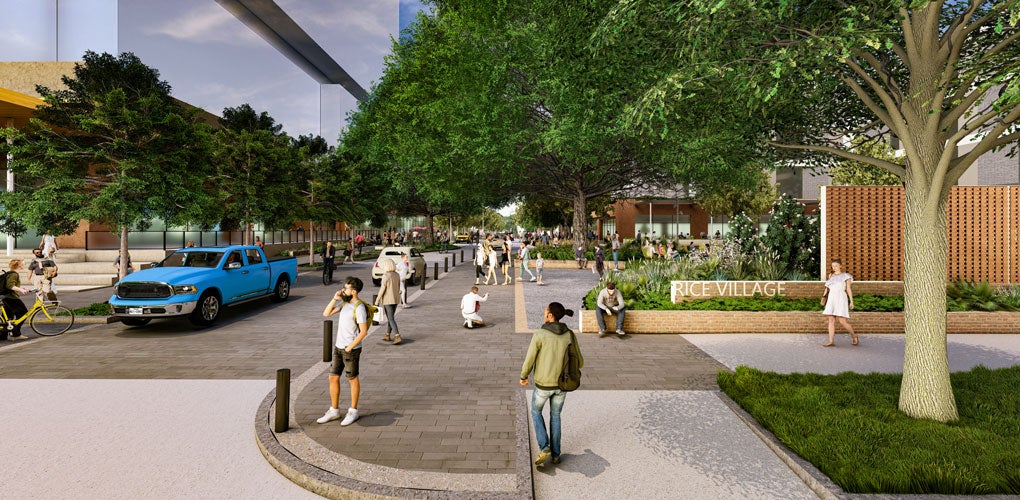
A central component of the Gateway Project is a new pedestrian-focused corridor that will extend Amherst Avenue toward campus, creating a clear, welcoming connection between Rice Village and the university. For generations of Owls, the Village has served as an informal extension of campus life — a place for meals after late lab sessions, a scenic study break or a quick errand between classes. The new corridor formalizes that relationship, transforming an underused edge of campus into a shaded, tree-lined path designed for gathering, relaxing and moving easily between the two areas.
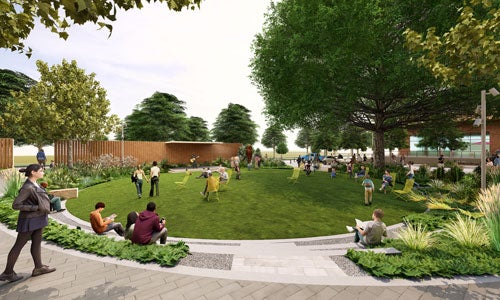
The corridor will incorporate green space, seating and space for community programming, making it not just a route but a destination. “By connecting our campus directly to the Village, we are strengthening our ties to Houston while enriching the student experience,” said Rice President Reginald DesRoches. “We are advancing our growth and reinforcing Rice’s commitment to innovation and community.”
Surrounding mixed-use development — featuring dining, retail and housing — will bring renewed energy to the district, creating a lively and intuitive “front door” to campus that reflects Rice’s distinctive scale and character.
Reimagining a Rice icon
Just steps from the new corridor, Rice Stadium will undergo a transformation that honors its storied past while preparing it for future generations. The 75-year-old venue has long been a touchstone of the Rice experience, from President John F. Kennedy’s “We choose to go to the moon” address to countless game days shared by alumni, students and fans.
The venue will be transformed into a “stadium in a park” — a modern, community-focused complex that enhances the fan experience, prioritizes sustainability, and offers greater flexibility for hosting a wide range of sports and events.
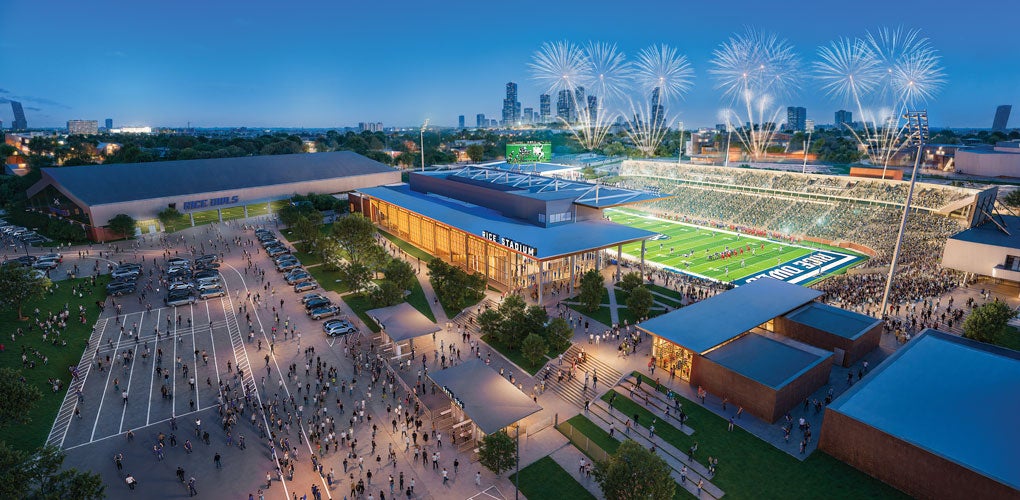
“This signals a new era for Rice Athletics,” said Tommy McClelland, vice president and director of athletics. “The enhanced Rice Stadium will offer a best-in-class experience for our student-athletes, fans and alumni while positioning Rice to compete at the highest levels athletically and academically. It will be a place of pride for the university and for Houston.”
The west side of the stadium will be dramatically overhauled, with a new three-level west concourse building that will house premium club seating, private suites, and new spaces for media and game operations. A shade canopy will extend from the top of the concourse over a portion of the lower bowl and the suite-level outdoor patio, creating a comfortable space for private events, recruiting, alumni gatherings and more. Additionally, a new 360-degree concourse will allow fans to move freely around the stadium, two new restroom and concession facilities will be added, and a new kitchen commissary will enhance the fan experience by providing a greater range of high-quality food options.
A greener, more connected west side
Rice Village has always been tightly woven into the fabric of the university. Today, Rice Real Estate Co. — the largest landowner in the Village — continues to shape its vitality. With more than 60 merchants, including national brands, local restaurants and independent boutiques, the Village remains one of Houston’s most beloved destinations. The Gateway Project reinforces this relationship by prioritizing pedestrian activity and outdoor gathering, creating a district that engages students, alumni and Houstonians alike.
“This project gives us a unique opportunity to open the western edge of campus and create a more welcoming gateway between Rice and the city,” said Ken Jett, president of Rice Real Estate Co. and vice president for facilities and capital planning.
The west side of campus — long a quieter, less-traveled edge — will be transformed into a more cohesive district. Older structures will make way for a redesigned greenway featuring native landscaping, permeable surfaces and natural stormwater elements. The new landscape will make it easier to travel from campus to the Village on foot or bike, while also providing quiet areas for reflection and outdoor study.
“The Gateway Project brings together long-range planning, academic mission and sustainability in a way that aligns with Rice’s future,” said Kelly Fox, executive vice president for operations, finance and support. “It is a deliberate effort to remove the boundary between the university and Rice Village in ways that are walkable, livable and welcoming.”
Construction on the stadium and gateway components will continue through 2028, marking a significant next chapter in Rice’s long tradition of purposeful campus development. When complete, the west side of campus will offer a renewed sense of openness and possibility — an environment that supports student life, enhances Rice’s athletics identity and strengthens the university’s connection to the Houston community.
“This is a generational investment in the growth and vitality of Rice University,” said Robert T. Ladd, chairman of the Rice Board of Trustees. “By physically linking our university to one of Houston’s most dynamic neighborhoods and modernizing a cornerstone of our athletics district, we are honoring Rice’s legacy while paving the way for future growth, connectivity and impact.”
Rice Stadium Through the Years
1950
A Modern Stadium, Built in Record Time
Rice Stadium opens after just nine months of construction, with 70,000 seats and an innovative poured-in-place concrete design, becoming one of the nation’s most modern college football venues.
1962
‘We Choose to Go to the Moon’
President John F. Kennedy delivers his historic Moon Speech at Rice Stadium, cementing the venue’s place in national history and linking Rice to the future of space exploration.
1974
Super Bowl VIII
Rice Stadium hosts Super Bowl VIII, the only Super Bowl ever played at a university facility. The Miami Dolphins beat the Minnesota Vikings 24-7.
1988
Monsters of Rock Tour
Headliners Van Halen, Metallica, Scorpions and Dokken played one of the stadium’s loudest and largest rock shows ever, a defining moment of the heavy metal era.
1994
An Upset for the Ages
Rice defeats the University of Texas 19-17, ending a 28-year drought and becoming an enduring moment in Owl Athletics lore.
1999
George Strait Country Music Festival
Strait, a Texas music icon, helped launch the modern era of country music in Houston with future megastars Tim McGraw, The Chicks, Kenny Chesney, Jo Dee Messina and Asleep at the Wheel.
2025–28
A New Era
The Gateway Project launches a comprehensive renovation, preparing Rice Stadium for the next generation of Owls.
— Sarah Rufca Nielsen
From the Winter 2026 issue of Rice Magazine
Body