
More Than Words
John Baugh on the legacy of linguistic profiling and how Rice’s linguistics initiatives are addressing communication challenges in Texas and beyond.
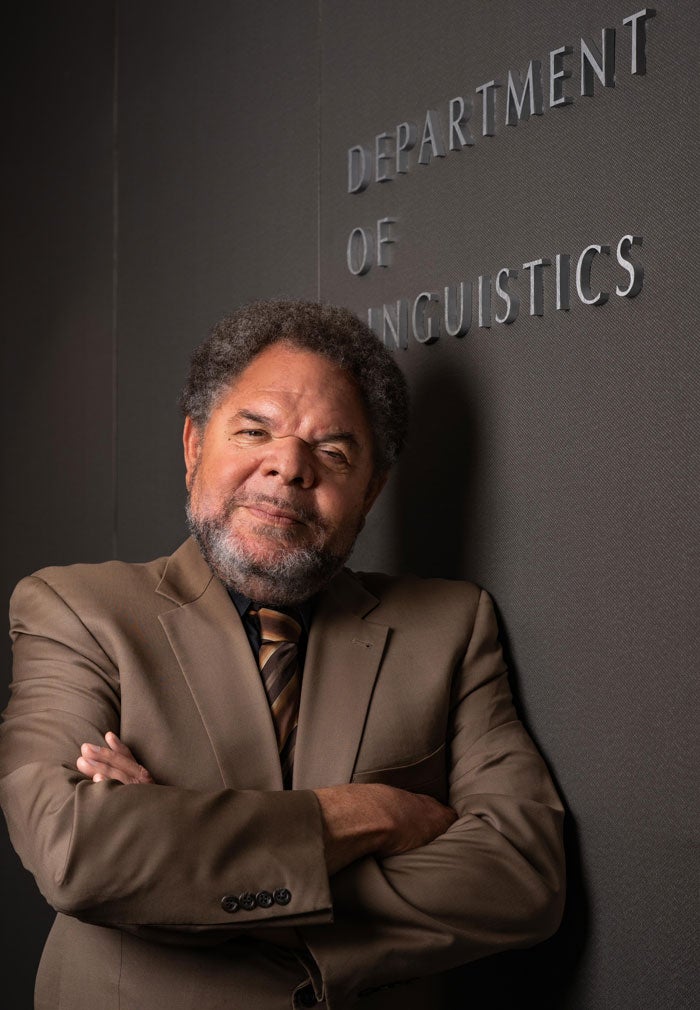
By Sarah Rufca Nielsen
Sociolinguist John Baugh, the Barbara Jordan Distinguished Professor of Linguistics, is leading a bold, new statewide effort to elevate the study of language in Texas. Through the Texas Linguistics Consortium and Rice’s new Center for Advancing Linguistic Science, Baugh is uniting top scholars to address real-world communication challenges in one of the nation’s most diverse states. Together, they aim to expand research, strengthen community partnerships and broaden access to linguistics education.
I’ve noticed that linguistics is sometimes grouped into the humanities, but at Rice it’s part of the social sciences. How do you define it?
It is a social science, and it is very much a science. Linguistics is the study of what all human languages have in common. Every language has a sound system, a structure and meaning, shaped by context. We study how infants acquire language, how dialects emerge and how factors like region, education or heritage influence speech. That’s where my own specialization, sociolinguistics, comes in.
How did you come to coin the term ‘linguistic profiling’?
For many years, I’d been interested in linguistic discrimination — the idea that people can be judged or limited not by their race or gender, but by how they sound. The concept of racial profiling came into public awareness in the 1990s when police officers were shown to pull over disproportionate numbers of Black drivers. That’s when it dawned on me that my work on linguistic discrimination might benefit from being referred to as linguistic profiling — the aural equivalent of racial profiling.
How is linguistic profiling different?
It turns out that linguistic profiling is much more nuanced than racial profiling. And it’s global. For example, there is research on linguistic discrimination against Uyghurs in China speaking Chinese. I sometimes ask my students to imagine an all-white America, where slavery never happened and everyone is of European descent. Would linguistic discrimination still exist? Almost always, they say yes — based on region, class or education. Once you add race and the unique linguistic history of slave descendants, you see how race and dialect intertwine.
What was the impetus for starting the Texas Linguistics Consortium in 2025?
We created the Texas Linguistics Consortium explicitly to build a network of linguists based here in Houston but serving the entire state. The goal is to lay a strong foundation — one that connects Rice’s strengths in research and global collaboration with Texas’ extraordinary linguistic diversity and the everyday challenges of communication, education and inclusion.
What makes Texas interesting from a linguistic standpoint?
Texas is an incredibly rich place to study language. Each region — El Paso, the Valley, Dallas, Austin, Midland — has its own distinct linguistic and cultural identity. That diversity makes Texas an ideal setting for studying how language evolves across geography, history and community. It’s uniquely Texan but also profoundly American.
From the Winter 2026 issue of Rice Magazine