
Mixed Media
With help from the Moody Center and the Arts Initiatives Fund, Rice faculty are exploring a new, artistic canvas for scholarship and collaboration.
By Sarah Rufca Nielsen
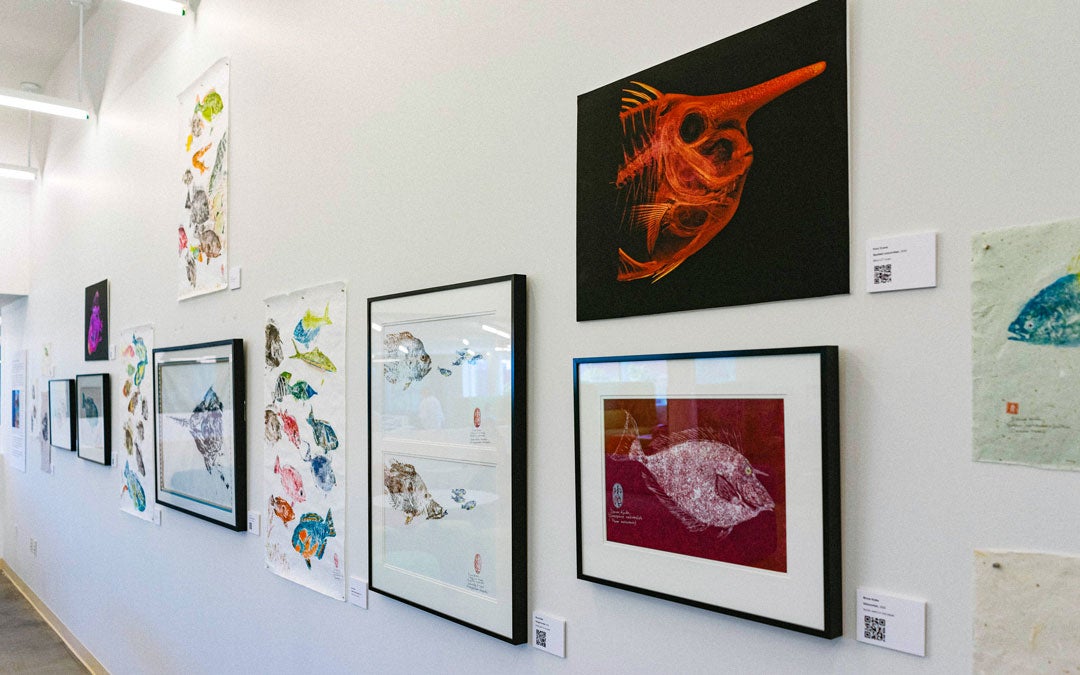
At first glance, the shimmering blues, golds and purples of “Colors of the Reef: Exploring the Diversity of Coral Reef Fishes” is a purely aesthetic wonder. But behind every print and image lies a story of discovery — one that blurs the boundaries between art and science.
The 2025 exhibition at the Moody Center for the Arts showcased work led by Kory Evans, assistant professor of biosciences, whose research examines how bony fish adapt, diversify and survive amid a rapidly changing climate.
“Coral reefs are among the most biodiverse ecosystems on the planet,” Evans says. “They’ve supported intricate webs of life for millions of years, and yet they’re some of the most vulnerable to warming oceans. Through this exhibit, we wanted to show both their beauty and their fragility.”
Evans’ project paired gyotaku, a traditional Japanese fish-printing technique, with high-tech micro-CT scans that map the skeletons of reef fish in 3D. The result is a marriage of 19th-century artistry and 21st-century imaging — and a striking example of what happens when Rice faculty step outside their disciplinary comfort zones.
That kind of creative cross-pollination is exactly what the Arts Initiatives Fund and Moody Center for the Arts were designed to support. Through AIF grants, faculty across Rice are encouraged to weave artistic methods into research and teaching.
Those collaborations have taken some unexpected turns. In the French department, Julie Fette collaborated with a professional cartoonist to help students build visual storytelling skills while exploring French culture through the lens of political cartoons, while April DeConick’s religious studies seminar had students crafting masks inspired by spiritual symbolism.
“We see the Moody as a connector — a space where biologists might meet artists, or philosophers meet materials scientists, and dream up something new,” says Erin Rolf, associate director of the Moody Center. “When faculty outside the arts want to bring that creative element into their classes, we help them make it happen.”
When Evans was working with the Moody team to install the fish prints, it was suggested that he perhaps arrange more of the warm- and cool-colored prints together for a more harmonious display. “Well, these fish all feed at the same depth in the ocean, so they would be together,” he replied. And just like that, the logic of a coral reef trumped the logic of a gallery wall. Because at Rice, creativity isn’t confined to one discipline. It’s what happens when they all swim together.
From the Winter 2026 issue of Rice Magazine