
A Campus, Curated
Rice’s expanding public art collection is anchored by a handful of site-specific works that illustrate the beauty of academic ideas.
By Sarah Rufca Nielsen
At Rice, art doesn’t just beautify the campus — it infuses classrooms and quads alike with a deeper sense of personality and identity. Under the curation of Moody Center executive director Alison Weaver since 2018, a collection that began with Michael Heizer’s iconic “45°, 90°, 180°” has grown to nearly 100 artworks rooted in geometric abstraction, light and space (plus a few owls, of course).
What distinguishes Rice’s approach is its commitment to site-specific art that reflects the university’s culture of scholarly inquiry. Whether it’s a signature work like James Turrell’s “Twilight Epiphany” Skyspace or a new commission shaped by student voices, these artworks transform everyday pathways into places of observation and ideas. We asked Weaver to highlight a few pieces created specifically to speak to their place on campus.
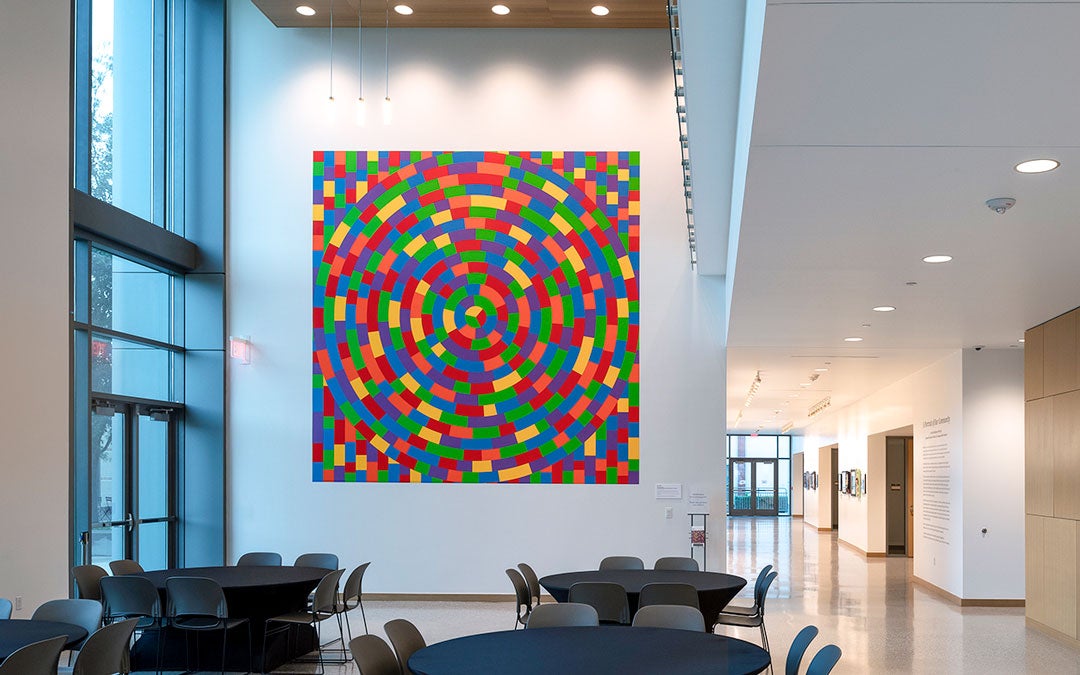
Sol LeWitt
“Wall Drawing #1115,” 2004
Anderson-Clarke Center
One of the most innovative artists to emerge in the 1960s, Sol LeWitt was a leading practitioner of conceptual art, a movement that prioritizes the idea inherent in a work of art over its physical execution. Each of LeWitt’s wall drawings can be recreated according to a set of instructions provided by the artist — like an architectural drawing or musical score, it is uniquely interpreted each time it is installed. “Sited in the Glasscock School of Continuing Studies, it seems fitting that an artistic celebration of an idea’s enduring power should enliven a space dedicated to lifelong learning,” says Weaver.
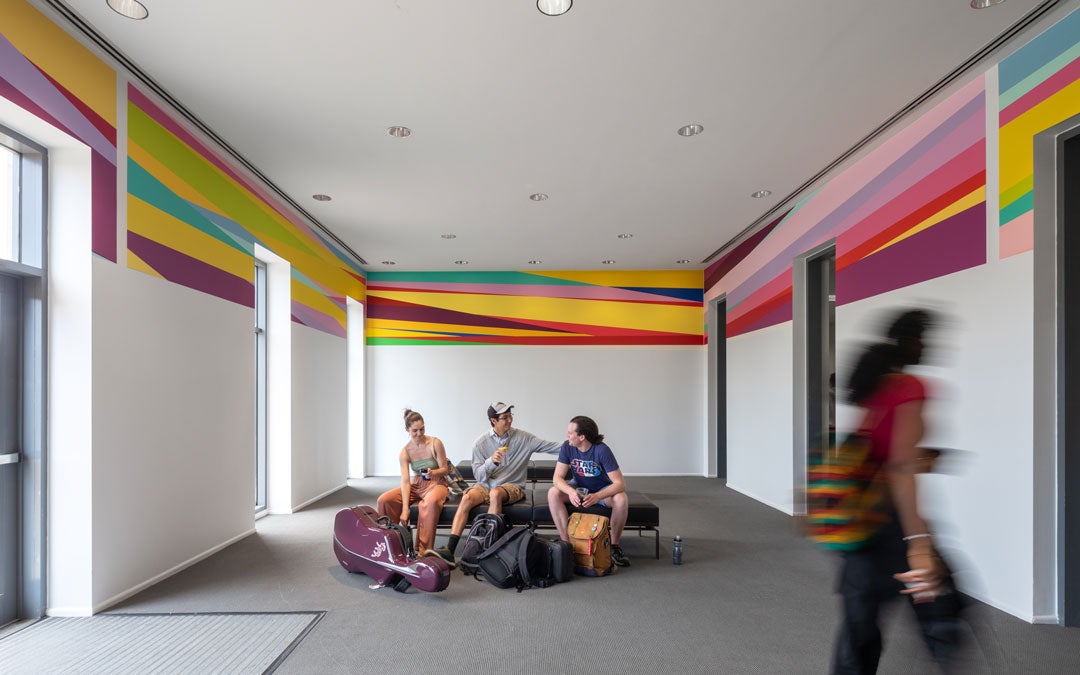
Odili Donald Odita
“Meeting Place / Painting with Changing Parts,” 2022
Alice Pratt Brown Hall
Odita’s vibrant wall painting animates the Shepherd School of Music’s central corridor
with rhythmic color and geometric movement. Blending influences from Western abstraction and African visual traditions, the work resonates with the building’s musical purpose. “The visual conversation this work creates with the neighboring Skyspace is remarkable,” Weaver says. “You can see the influence of Turrell’s engagement with color and light, while feeling the rhythm of forms inspired by contemporary classical music.”
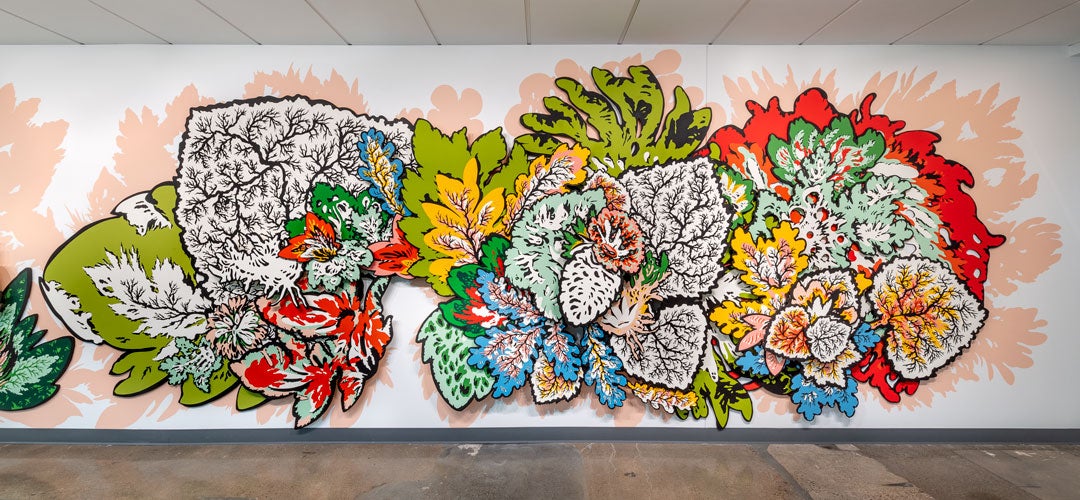
Natasha Bowdoin
“Power Flower,” 2021
MD Anderson Biological Laboratories
Bowdoin’s expansive, nature-inspired mural blooms across the biology building, reflecting the study of life in all its complexity. Mixing botanical forms with patterns reminiscent of shells, scales and wings, the work mirrors the building’s investigations into classification, adaptation and the structures that shape living systems. The first piece in the collection created by a Rice faculty artist, the work transforms the space into a vivid ecosystem, reminding students and researchers that the natural world resists easy boundaries — and rewards close observation.
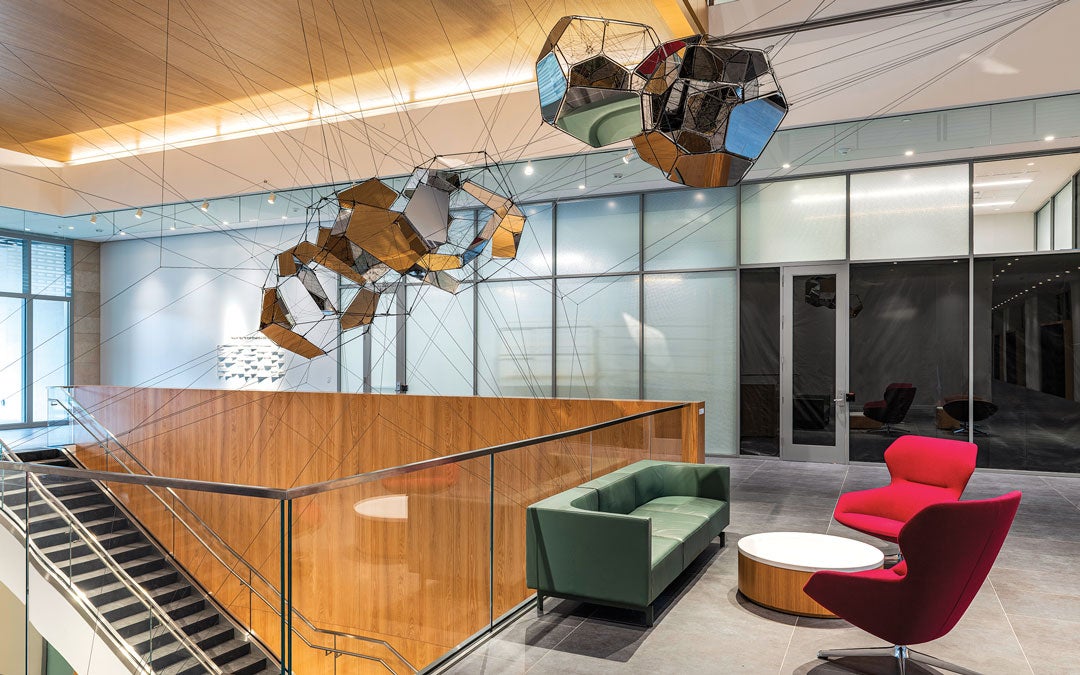
Tomás Saraceno
“Crux Australis 68.00,” 2023
Ralph S. O’Connor Building for Engineering and Science
Suspended above the O’Connor building’s atrium, Saraceno’s intricate, cloudlike structure mirrors the building’s collaborative research culture. Its reflective, geodesic forms echo the interconnected thinking that drives engineering and scientific discovery at Rice. As viewers move beneath the shifting network of fibers, the piece becomes a visual metaphor for shared inquiry. “You can immediately sense the artist’s appreciation for science and engineering as areas of academic study and as a lens through which we can appreciate the structures of the natural world,” notes Weaver.
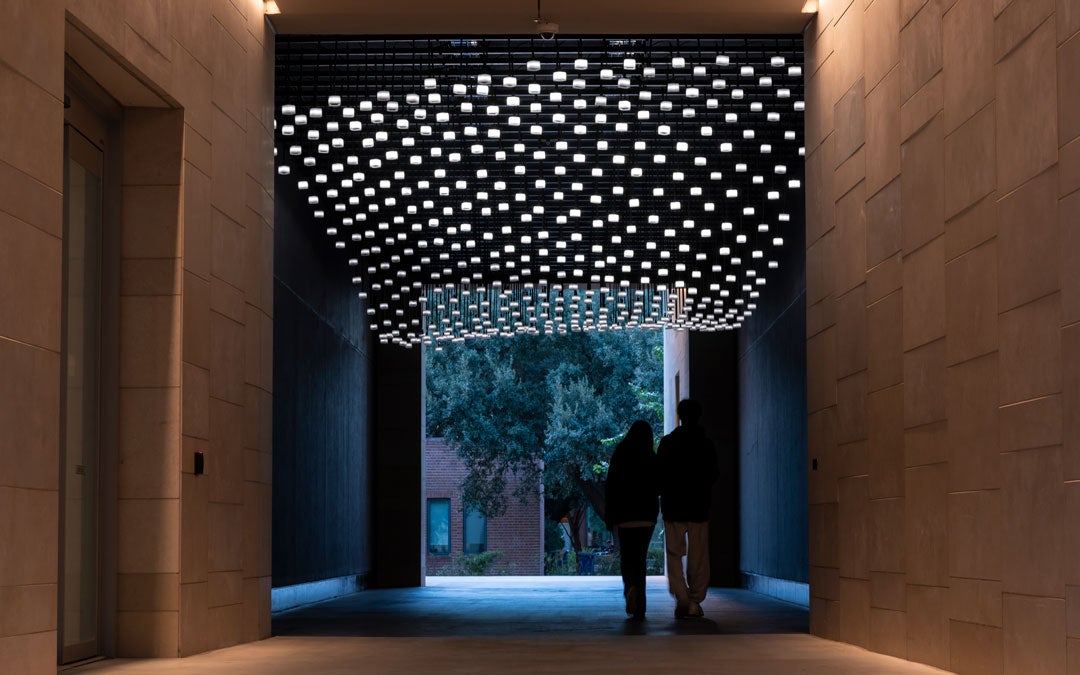
Rafael Lozano-Hemmer
“Climate Parliament,” 2024
Ralph S. O’Connor Building for Engineering and Science
In this immersive installation, 481 hybrid speaker-lights suspended from the ceiling of an enclosed exterior passageway respond to any movement below, creating a chorus of voices — including Rice researchers and students — discussing climate science. It’s a striking fit for a building devoted to interdisciplinary research, turning the pathway into a dynamic forum for environmental inquiry. “This is one of our most technologically ambitious public art works,” says Weaver. “When you hear the voices overhead, you’re inspired to stop moving and really listen, which makes this work conceptually powerful while also being visually and sonically dazzling.”
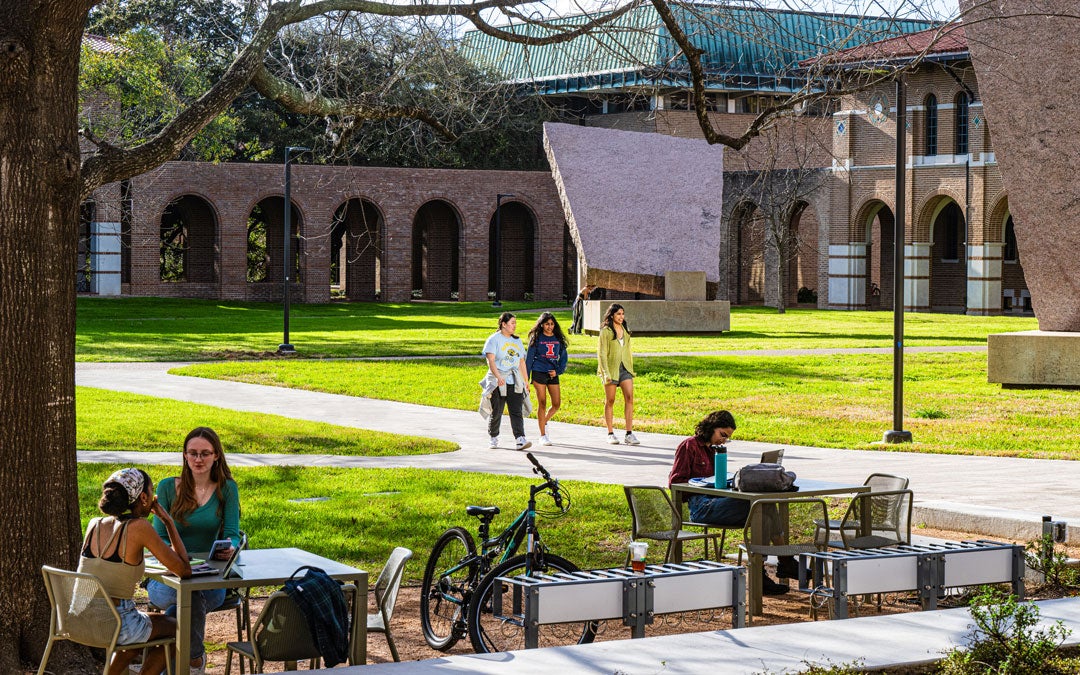
Michael Heizer
“45°, 90°, 180°,” 1984
Engineering Quadrangle
Heizer’s granite triptych remains a touchstone of public art at Rice and a natural fit for the Engineering Quad. Each monolith, positioned to mark fundamental geometric angles, embodies the precision, problem-solving and structural thinking at the core of engineering education. Installed with exceptional technical difficulty, the work encourages students to consider scale, balance, and the relationship between form and function. Decades after its arrival, the piece still anchors the campus as both an artistic landmark and a reminder of the discipline’s foundations.
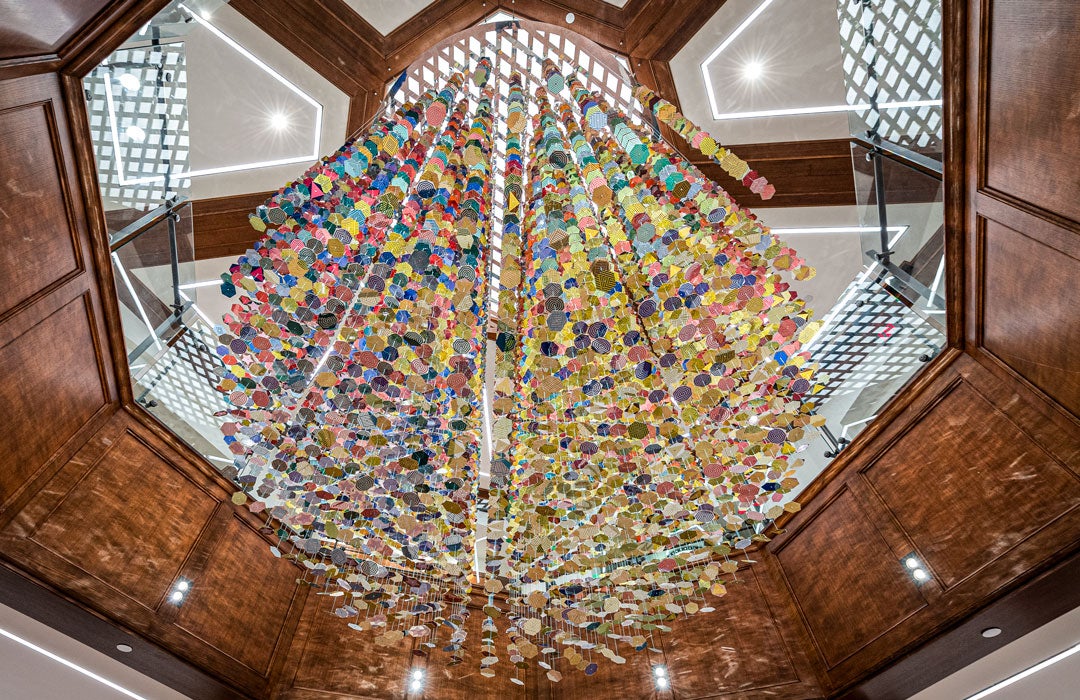
Pae White
“Triple Virgo,” 2021
McNair Hall
Floating above the main rotunda in the home of Rice Business, White’s constellation of colorful discs responds to shifting light and movement, forming an ever-changing sphere. Its global, forward-looking energy reflects the business school’s international reach and its emphasis on navigating complex, interconnected systems. As visitors walk beneath the suspended forms, the piece suggests the expansive thinking — and openness to possibility — that drives entrepreneurial and strategic learning at Rice.
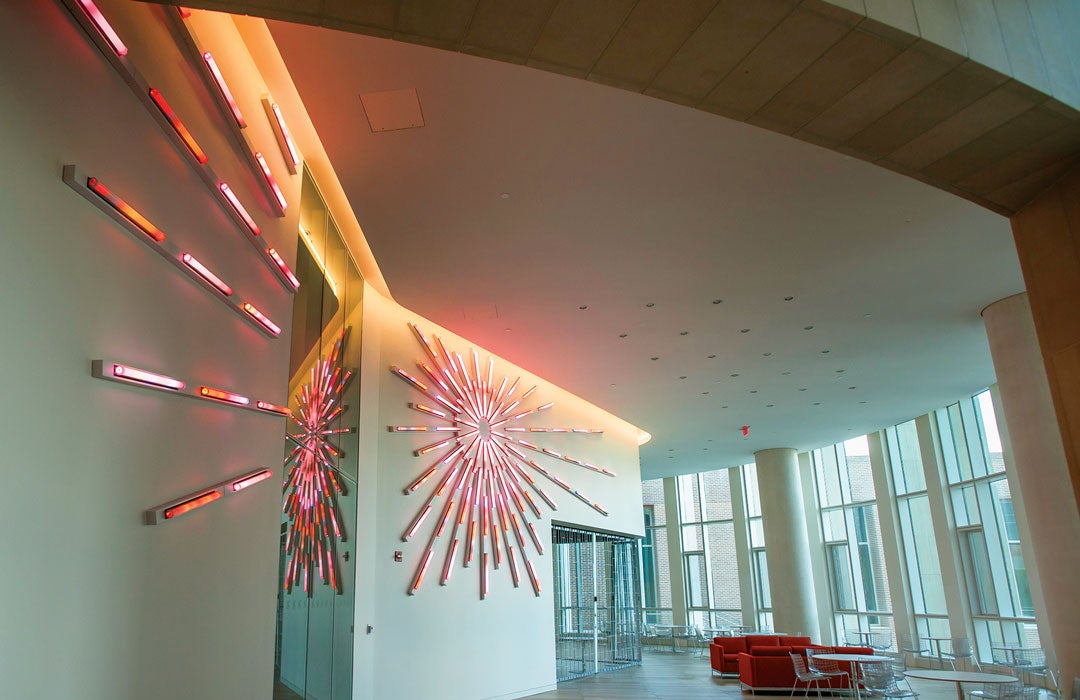
Leo Villareal
“Radiant Pathway,” 2010
BioScience Research Collaborative
Villareal’s LED installation radiates from the BRC ceiling like a coded starburst, echoing the building’s focus on discovery driven by data, pattern and experimentation. The work’s custom algorithms and never-repeating light sequences reference mathematical models and biological systems, reminding viewers how research evolves through iteration and curiosity. Inspired by mathematician John Conway’s studies, the piece connects computational logic with artistic expression — an illuminating nod to the interdisciplinary science unfolding just steps away.
From the Winter 2026 issue of Rice Magazine
Body