
Moody Fellowship Brings History Close to Home
For Michael Garcia, researching labor history in the Rio Grande Valley is also an act of recognition.
By Brandi Smith
Michael Garcia’s thesis research began in the archives, but its roots run much closer to home.
A senior majoring in history and business with a minor in politics, law and social thought, Garcia has spent his final year reconstructing the lives of agricultural workers in the Rio Grande Valley, tracing stories of labor, migration and survival that echo his own family history. He presented his thesis in April at the Humanities and Arts Festival, where students from across disciplines share original research and creative work.
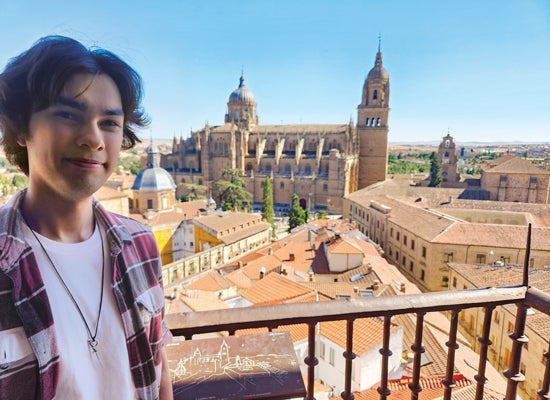
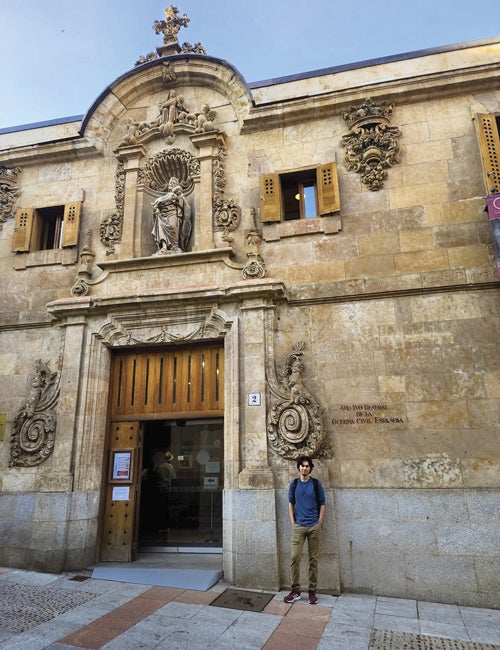
Garcia’s research path began with the Elizabeth Lee Moody Undergraduate Research Fellowship in the Humanities and the Arts, which supports Rice students dedicated to pursuing critical humanities-based research and innovative creative work. His Moody stipend enabled him to spend a summer in Spain studying Mexican volunteers in the Spanish Civil War. There, in letters, hospital records and commendations, he found voices often left out of dominant historical narratives.
“We tend to forget that this was a war happening in Spain, and yet Latin American voices are almost entirely absent from the way it’s discussed,” Garcia says.
That archival work laid the foundation for his senior thesis. Garcia now focuses on agricultural labor in the Rio Grande Valley during and after the Bracero Program, the binational agreement established in 1942 that brought millions of Mexican men to the United States as temporary workers. His project examines how those labor systems and migration patterns persisted long after the program officially ended in 1964.
“My job was to really analyze the archives,” Garcia says. “It was to go back into those libraries, back into those boxes and boxes and boxes of paperwork, and really get to see what their lives were like.”
To answer those questions, Garcia spent months in regional archives, including the Museum of South Texas History in Edinburg and special collections at the University of Texas Rio Grande Valley.
“Michael is such a brilliant and thoughtful student,” says Laura Correa Ochoa, assistant professor of history in the School of Humanities and one of Garcia’s advisers. “Ever since he took my first class several years ago, I’ve been so impressed by his intellectual rigor, curiosity and work ethic. His enthusiasm for archival research and historical analysis has been wonderful to see. He works so hard and cares deeply about everything he works on.”
For Garcia, the project is also personal. His parents worked as field laborers in the same region he now studies.
“All I can think of is my parents,” he says. “All I can think of is my sister and my brother and myself and realize that [the braceros], in so many more ways than I can possibly know, are like me.”
The work, Garcia says, feels especially urgent now. “I think that in today’s political climate, it’s so important to uncover these stories of endurance and durability and survival because we need those, too.”
From the Spring 2026 issue of Rice Magazine