
A Light Bulb Moment
What if one of history’s most famous inventions held the key to making graphene more affordable?
By Rachel Leeson
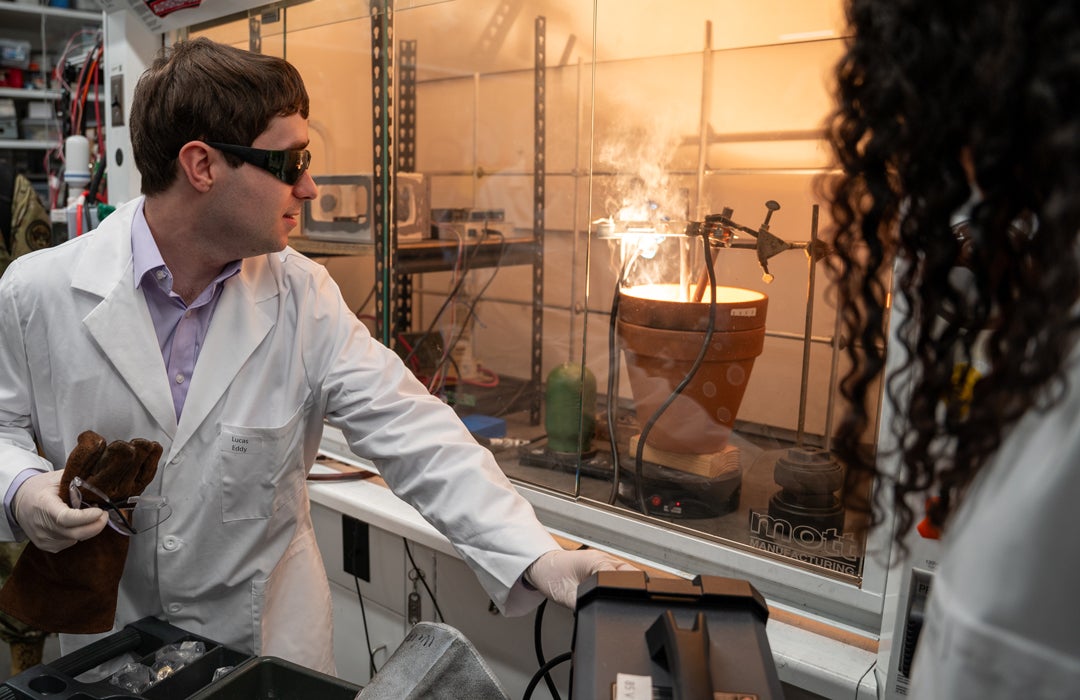
Lucas Eddy ’25 spent his years at Rice looking for inspiration. A lightning strike, if you will. And when lightning strikes didn’t work out, he turned to light bulbs. Specifically, the light bulbs Thomas Edison developed to produce the first stable source of electric light.
In 2024, Eddy was a Ph.D. student looking for ways to improve the production of graphene, a carbon-based nanomaterial with a wide variety of uses in modern technology. In a lab, graphene is created with flash Joule heating, where a carbon-based substance is rapidly heated to between 2,000 and 3,000 degrees Celsius. Eddy, an energetic scientist with an easy smile, wanted to create graphene using accessible and inexpensive materials.
He first looked to nature, trekking out into fields to sample trees struck by lightning. “A complete dead end,” he says. “We couldn’t find any graphene.”
Then he thought about arc welders, which produce electrical arcs somewhat like tiny versions of lightning. They could produce graphene “better and more effectively than anything I’d ever built,” he says. But the process was not, unfortunately, cheaper or more accessible. Back to the drawing board.
When lightning, natural or manmade, didn’t pan out, Eddy tried another tack. “I was trying to figure out the smallest, easiest piece of equipment you could use for flash Joule heating,” he says, “and I remembered that early light bulbs often used carbon-based filaments.”
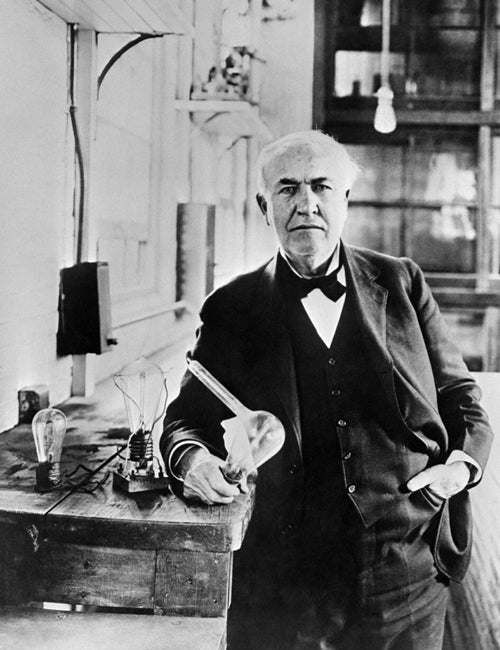
Filament-based light bulbs, more commonly called incandescent light bulbs, rapidly reach 2,000–3,000 degrees Celcius when turned on. While modern filament light bulbs typically use a metal filament made of tungsten, the early prototypes Thomas Edison used were carbon-based, made from Japanese bamboo. Eddy realized that in Edison’s quest to provide stable electric lights, the prolific inventor might have also unknowingly produced graphene.
So Eddy set off to find a light bulb with a carbon-based filament. He started by ordering carbon filament light bulbs from light bulb retailors, but what arrived wasn’t carbon — they were all tungsten filaments. “You can’t fool a chemist,” says Eddy, who studied in chemist James Tour’s lab despite earning his Ph.D. in applied physics.
Eventually, Eddy found a specialty art store in New York City offering artisan Edison-style bulbs with filaments made of carbon-based Japanese bamboo. They were virtually identical to Edison’s original bulb, with a difference in diameter of less than 5 micrometers. Eddy attached the light bulb to a 110-volt DC electricity source, the same type Edison had used in his famed 1879 experiment, flipped the switch on, and then switched it back off after 20 seconds. (Any longer and he risked potential graphene turning into graphite.) Then he carefully collected samples from the filament and tested them.
The tests came back positive. Eddy had replicated Edison’s 19th-century experiments and created graphene, a 21st-century material. To say he was excited is an understatement — Eddy brought the experimental setup to his thesis defense and produced graphene right in front of his audience.
Of course, there is no way to really know what happened during Edison’s experiment nearly 150 years ago. Even if the original light bulb he used was available to analyze, any graphene produced likely would have turned to graphite during its first 13-hour test.
But Eddy says that’s okay. This experiment wasn’t about certainty. It was about connecting with science history; revisiting old experiments with new curiosity and techniques, exploring the past through a modern scientific lens to find inspiration for the future.
From the Spring 2026 issue of Rice Magazine