
Field Notes
Jen Cooper has built a career tracking the rise of women’s soccer.
By Jennifer Latson
In 2024, as the U.S. women’s national soccer team was vying for Olympic gold against Brazil, NBC commentators Julie Foudy and Jon Champion paused to note how many members of both teams also played for the U.S. National Women’s Soccer League.
“I did the math on that,” Foudy said. “61%, when you add in the alternates, of the 44 players . . .”
“Julie, Julie, can I stop you there?” Champion interrupted. “You didn’t do the math on that. Our researcher, Jen Cooper, did the math on that.”
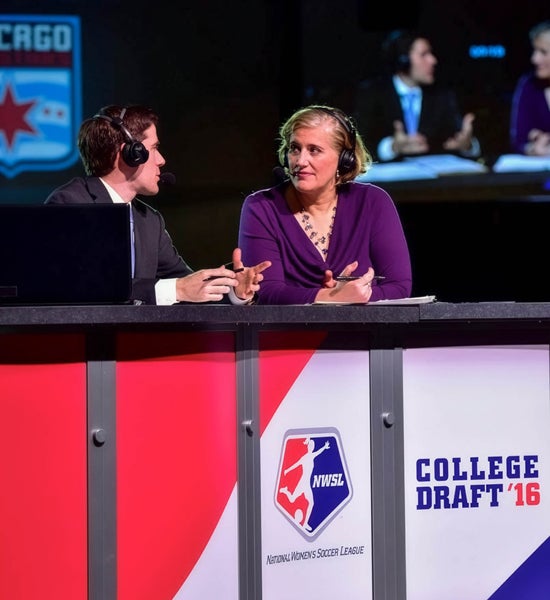
The shoutout wasn’t a surprise for many who knew Jen Cooper ’90 at Rice, who has long been known for her soccer fandom and for her research prowess. Now the broadcast stats manager and historian for the NWSL, she has also worked as a soccer researcher for NBC, Fox Sports and other media outlets. This summer she’ll be covering her third World Cup for Fox, having previously traveled to Russia and France with the network in 2018 and 2019.
Although Cooper played soccer recreationally in the early 1990s, she was lukewarm about the sport until she watched the 1994 World Cup. “That was my first time seeing truly competitive professional soccer, and it flipped the switch for me,” she says. “Just the intensity that comes with it, and the fierce devotion different countries had to their teams. It caught me.”
Though she also covers men’s soccer, the women’s game is her primary passion. She produces an annual women’s soccer almanac and maintains a website, Keeper Notes, that chronicles the history of women’s soccer in the U.S.
“I’ve always been an archivist,” she says. “At Rice, I kept a notebook where I was making notes on every Beer Bike race; that prepared me to be the ‘Keeper of Notes’ for women’s soccer.”
When Rice introduced women’s soccer in 2001, Cooper became a booster for the team. She successfully lobbied the Women’s United Soccer Association — the first women’s professional soccer league — to play an exhibition game on campus, which is how two of Cooper’s idols, Mia Hamm and Briana Scurry, came to play on the Rice pitch in 2002.
The WUSA folded after three seasons, but when the NWSL formed in 2012 — and Houston got its first professional women’s soccer team, the Houston Dash, a year later — Cooper was all in. While also working for the Houston MLS team and hosting a soccer radio show, she signed on as the broadcast analyst for the Dash. Once there, she realized that if she wanted stats about the team and its competitors, she was going to have to compile them herself.
“The league started on a shoestring. Of all the things you need to pay for to get a league started, the last thing you’re thinking about is stats,” Cooper says. “I started charting a lot of things just out of my own curiosity [and] building spreadsheets.”
Those spreadsheets evolved into her annual almanac of NWSL data. Cooper says it’s been a labor of love more than a lucrative business venture, but it opened doors for her to build a career as a full-time broadcast researcher — as has the explosion in popularity of women’s soccer in recent years.
“The growth of the women’s game in all areas is amazing,” she says, “and I am so thrilled.”
From the Spring 2026 issue of Rice Magazine