
Color Field
MFAH intern Will Marsden conceived a display highlighting a major moment in Houston’s art history.
By Sam Byrd
For Rice University senior Will Marsden, a summer internship at the Museum of Fine Arts, Houston turned into a rare opportunity to help shape a historically resonant gallery installation that’s now on view.
Marsden, a business and art history major who interned in the museum’s modern and contemporary art department, spent months assisting curators with research, writing and collection work. The position exposed him to the behind-the-scenes curatorial process that determines how artworks are studied, interpreted and ultimately displayed for the public.

“In a curatorial office you’re working on everything that might come into the museum — gifts, potential loans and donations — as well as planning for upcoming exhibitions,” Marsden says. “Everything you see in the museum is very intentionally placed and interpreted for visitors.”
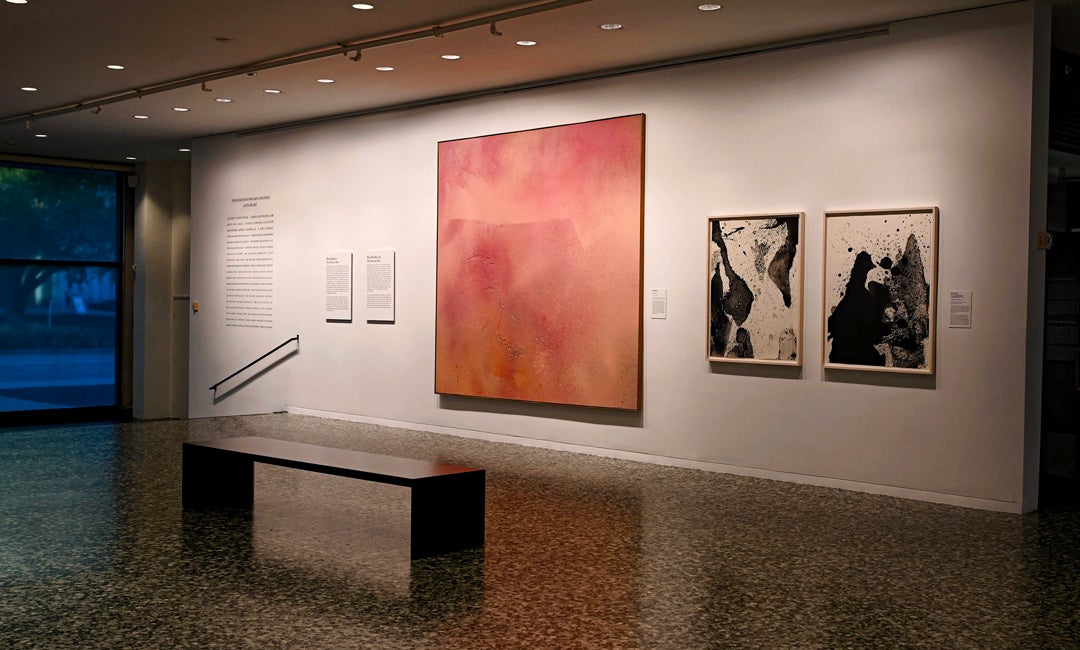
Marsden’s work included researching provenance, helping draft object labels and contributing to reports about works entering the museum’s permanent collection. When the MFAH was gifted “Milkwood” (1973), a painting by Black American artist Peter Bradley, through a museum exchange program, Marsden was asked to design a potential gallery layout that could incorporate the work as a hypothetical exercise. Drawing on the research he had already conducted, Marsden proposed an installation that would not only feature Bradley’s work but also connect it to a pivotal moment in Houston’s art history.
His concept ultimately became a real installation, “Peter Bradley and ‘The De Luxe Show,’” on display in the MFAH’s Law Building through May 31. It highlights Bradley’s role in the groundbreaking 1971 “De Luxe Show,” an exhibition held in Houston’s Fifth Ward that brought together artists of different racial backgrounds at a time when the art world was often segregated. The show took place at the DeLuxe Theater and was organized with support from patrons associated with the storied Menil Collection.
“It was one of the first racially integrated art exhibitions in the United States,” Marsden says. “It brought together artists from all over the country who were making some of the most innovative abstract work of the time.”
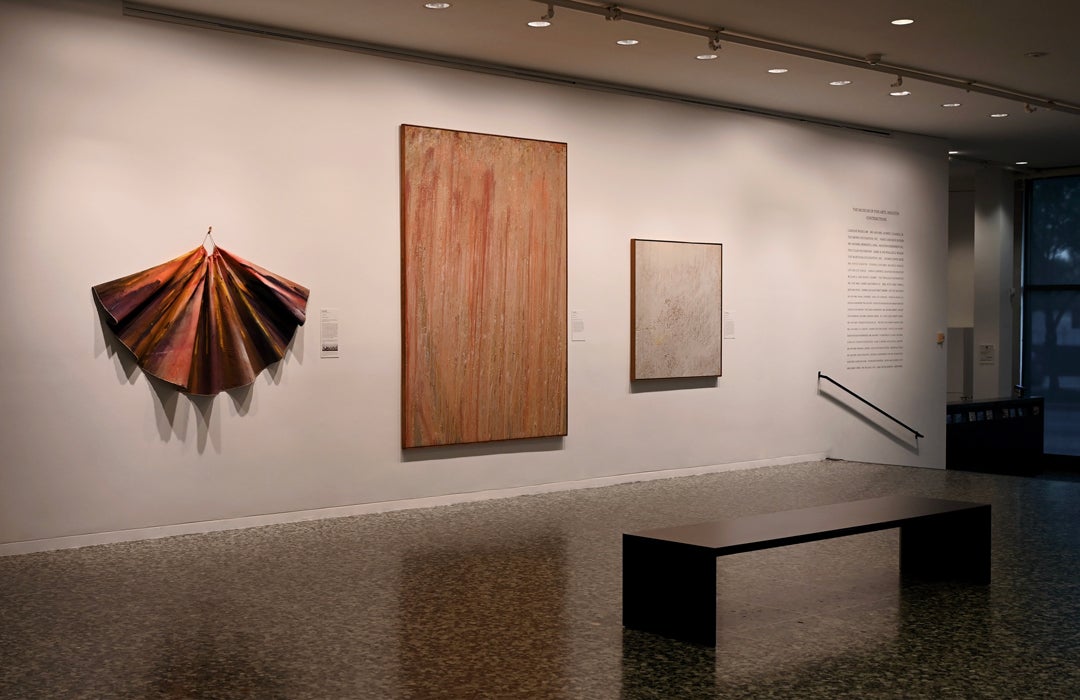
Marsden’s installation revisits that legacy by pairing Bradley’s signature canvases from the early 1970s and two recent, untitled lithographs with works by Anthony Caro, Sam Gilliam and Larry Poons — creative minds all connected to the same artistic moment. Many of them were associated with the Color Field movement, a style of abstract painting characterized by large areas of color meant to evoke emotion and contemplation, made famous by abstract painter Mark Rothko.
Through his research, Marsden encountered influential Houston art initiatives such as Rick Lowe’s groundbreaking Project Row Houses and the lasting cultural impact of “The De Luxe Show,” giving him a deeper appreciation of Houston’s art community.
“I had traveled a lot and seen museums in Europe,” he says. “But I didn’t really know the history of Houston’s art scene before this.”
The experience has shaped his career aspirations as well. Marsden now works as a gallery assistant in Houston and hopes to pursue a career in the commercial art world, potentially working with galleries or auction houses.
“Working at a museum of that caliber was a huge moment for me,” he says. “It showed me how dynamic the art world is and how many opportunities there are to connect artists, history and the public.”
From the Spring 2026 issue of Rice Magazine