
Colombia’s Unexpected Inheritance
Along the Magdalena River, a wild herd of hippos is a controversial reminder of the country’s troubled past.
By Kat Cosley Trigg
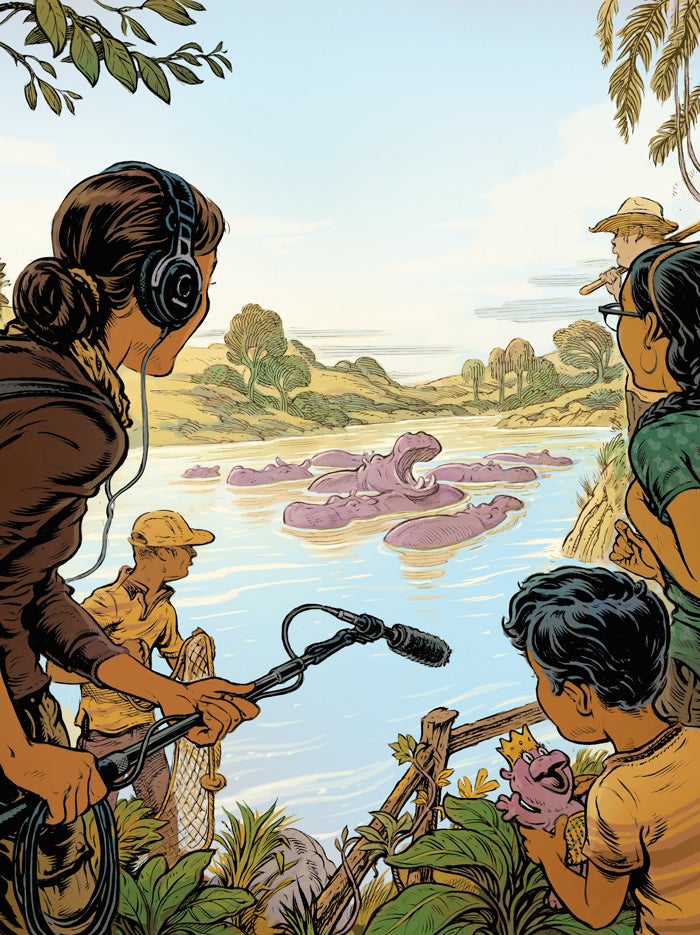
Alejandra Osejo Varona ’24, ’27 stands at the edge of Colombia’s Magdalena River, headphones on and field recorder in hand, scanning the surface for movement. Her gaze sweeps the broad ribbon of water, as fishermen cast their lines and the current carries decades of memory downstream. Her goal is to understand life along the mangrove-bound river that serves as Colombia’s commercial and ecological backbone.
A Rice Ph.D. candidate in anthropology, Osejo Varona searches for wide, pink-gray snouts popping up above the surface of the water. She is hoping to glimpse some of Colombia’s most unlikely and controversial residents — hippopotamuses.
Growing up in southwestern Colombia, Osejo Varona was captivated by what she calls “the diversity of beings, animals and plants woven into human life.” The Magdalena River and its tributaries weren’t just landscapes, they were living systems shaped by biodiversity, commerce and the long shadows of conflict. That proximity to both ecological richness and political violence now informs her research in deeply personal ways.
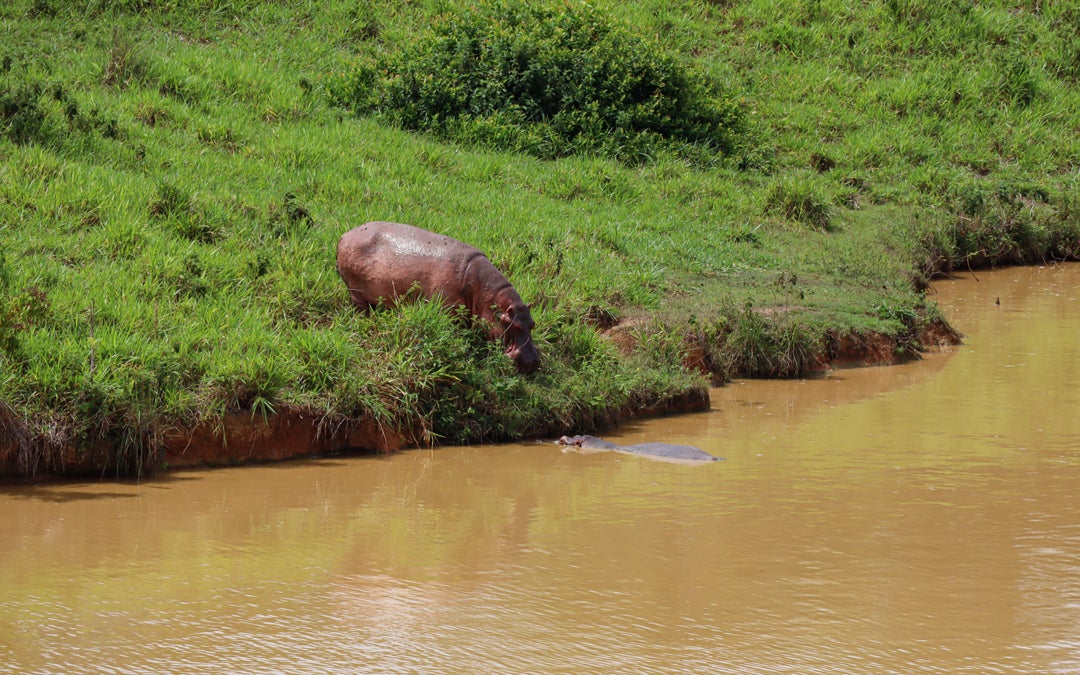
In the early 1980s, the infamous drug trafficker Pablo Escobar brought four hippos from Africa to Colombia as part of a private zoo on his Hacienda Nápoles compound, alongside giraffes, elephants, zebras and ostriches. After Escobar’s death in 1993, most of the zoo animals were relocated, but the hippos remained on the property, too difficult and expensive to move. Eventually they dispersed into nearby wetlands and riverways, thriving in an adopted home that provided abundant habitat and no natural predators. Today, more than a hundred hippos live in and around the Magdalena River basin.
Biologists classify them as a non-native species, meaning they evolved elsewhere and arrived through human intervention. In many parts of the world, invasive species are aggressively removed to protect native ecosystems. But hippos are not insects or plants — they are large, charismatic mammals deeply entangled with Colombia’s history.
And that is where the question emerges, the one Osejo Varona is asked again and again: What should Colombia do with the hippos? “It is the most difficult question,” she says. “If you take a side too quickly, you close the door.”
The Magdalena River is Colombia’s principal waterway, a corridor of trade, culture and memory. It is also a river that has witnessed profound violence. During decades of armed conflict linked in part to narcotrafficking, communities along its banks endured displacement, fear and loss. The river’s story cannot be separated from that past, nor can the hippos’.
Some scientists and policymakers argue that the hippos should be culled or sterilized to prevent further ecological disruption. Others see economic opportunity in their presence, pointing to tourism drawn by the novelty of hippos roaming South American rivers. Many local residents occupy a quieter middle ground. Some have adapted to living alongside them and no longer react with alarm. Others worry about safety but see the animals as only one of many daily challenges.
“This is not only an ecological problem,” says Osejo Varona. “It is social, historical and ethical.”
The hippos represent what she calls the environmental afterlife of violence — the way human decisions reverberate through ecosystems long after headlines fade. The animals were transported across continents as symbols of excess and power. Today, their presence forces Colombia to confront questions about responsibility, memory and coexistence.
When Osejo Varona arrived at Rice in 2021 as a Fulbright Foreign Student Award recipient, she envisioned a different research topic. But her previous work at the Alexander von Humboldt Biological Resources Research Institute, where she led research on environmental governance and equity, had exposed her to the growing debate. Osejo Varona realized the controversy was not simply about animal management. It was about how scientific expertise, government policy and local knowledge intersect — and whose voices are heard.
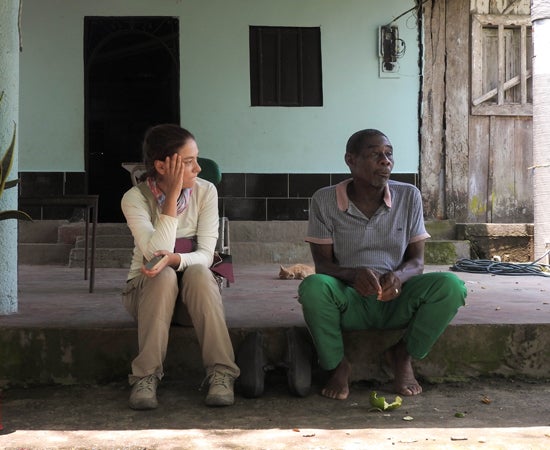
Her fieldwork reflects that intersection. She has lived for more than a year alongside rural communities in the Magdalena basin, listening to fishermen describe disappearing fish stocks, residents explaining how they have adapted to the hippos’ movements and tourism operators who see opportunity in these odd new mascots.
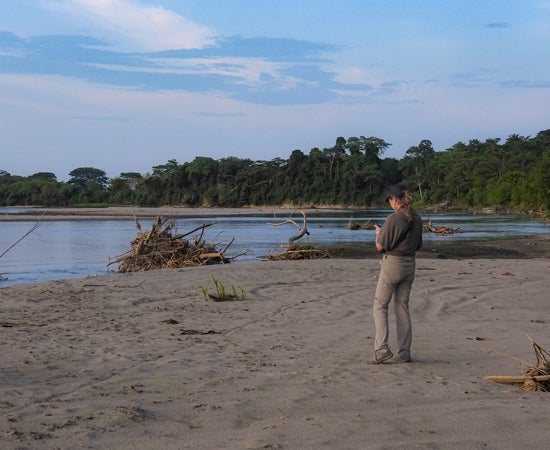
She also listens in another way. Working with scientists who use hydrophones and acoustic analysis, Osejo Varona studies how sound travels through the river. What does a hippo hear in a Colombian amusement park filled with music and tourists? How does underwater noise shift when large mammals enter an ecosystem? What changes in the river’s acoustic landscape when environments are altered?
By combining ethnography with sound technology, Osejo Varona invites collaboration across disciplines and across species. Her work is not about defending the hippos, nor condemning them. For her, the goal is not to settle the question of what should be done, but to widen the frame around how it is asked.
“One thing I am sure about,” she says, “is that the people who live with the hippos every day must be part of the decision.”
The story is far from finished. The hippos continue to reproduce and migrate into new stretches of the Magdalena, reshaping both ecosystems and conversations. The research continues as well: Osejo Varona is now writing her dissertation, with plans to defend in 2027, and will return to Colombia this summer to share her sonic and visual work with the communities who helped shape it.
Standing by the river, it is hard to separate the hippos from the water that carries them. They move slowly and deliberately, seemingly indifferent to the debates that swirl around their existence. And the river keeps moving, as it always has.
From the Spring 2026 issue of Rice Magazine
Body