
The Birth of the Buckyball
Richard Smalley and Robert Curl’s Nobel Prize-winning discovery led to a scientific and technological revolution.
By Ishani Kaul ’25
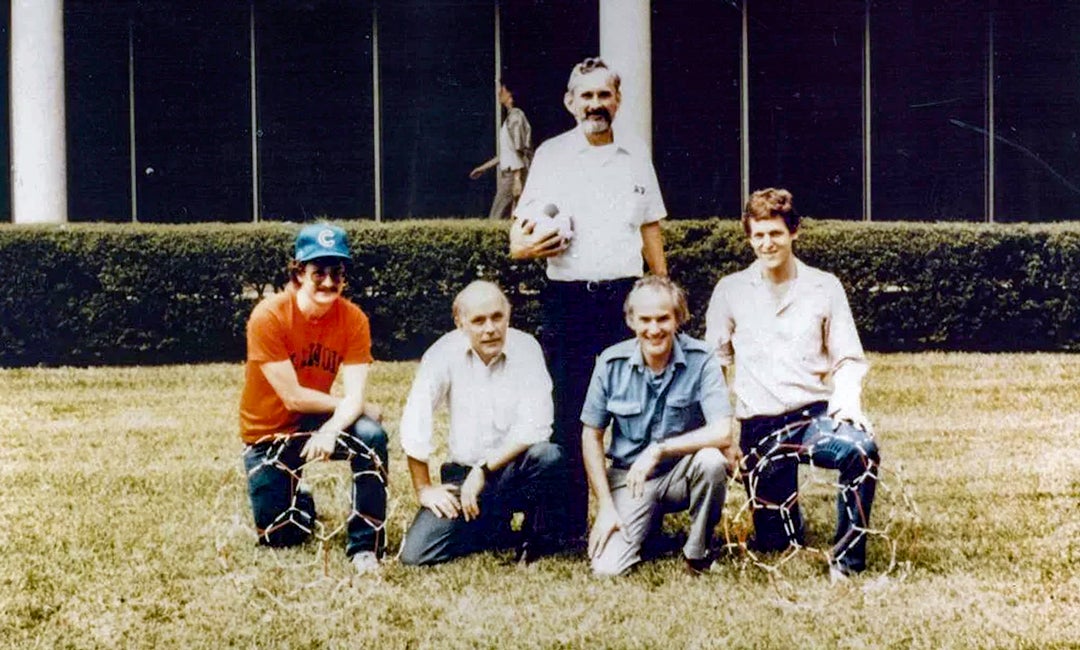
In 1985, scientists working out of a lab in Rice’s Space Science and Technology Building stumbled upon a strange, soccer-ball-shaped molecule. Their discovery, made after a whirlwind two weeks of experiments, culminated in a journal article barely two pages long that revolutionized nanotechnology and earned them the Nobel Prize in chemistry in 1996. The discovery of C60, also known as buckminsterfullerene or the “buckyball,” marked a defining moment in scientific history — and in the scientific legacy of Rice.
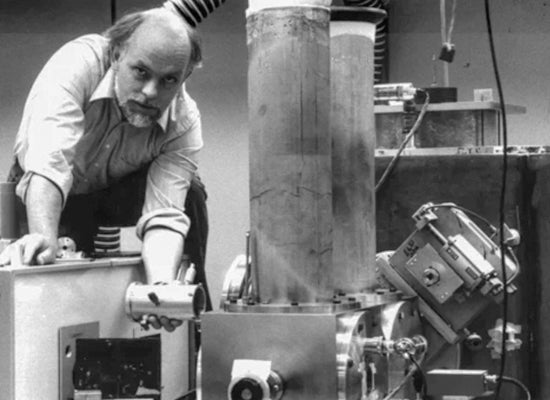
At the time, graduate students Sean O’Brien ’88 and Jim Heath ’88 were working in the lab of chemist Richard “Rick” Smalley, a hub of activity known for its cutting-edge cluster machine, AP2. O’Brien and Heath were initially focused on metal clusters, but with the arrival of Harold “Harry” Kroto in late August 1985, everything changed. Kroto was a British chemist from the University of Sussex and a friend of Robert Curl ’54, Smalley’s senior colleague at Rice. Full of enthusiasm for carbon research, Kroto persuaded the Rice team to explore carbon clusters, as he was particularly interested in seeing whether vaporized carbon would condense into clusters consistent with the carbon material observed in interstellar space.
Despite initial reluctance, the team began experimenting with carbon under Kroto’s guidance. The breakthrough came when O’Brien’s new nozzle design allowed them to produce carbon clusters in a way that scientists had not been able to before. Heath worked extensively to create carbon clusters of various sizes, but one cluster in particular was remarkable for its stability and ease of creation: C60.
After a week of intensive experimentation, Smalley assembled the team to reveal a cut-out paper model of a soccer ball — the shape of C60. “We all showed up at his office, and he had this cut-out paper model of a buckyball, and we just knew, ‘This has to be right,’” Heath says.
Although they had identified the buckyball, proving its structure to the scientific community was another challenge. The concept of a stable, hollow carbon structure was radical, and many doubted the team’s findings until 1990, when physicists Wolfgang Krätschmer and Donald Huffman were able to make C60 in bulk.
In his speech at the 1996 Nobel Banquet, Smalley reflected on the unique contributions each member brought to the team. “We had evolved one of the most intellectually demanding and penetrating styles of research I have ever witnessed in any research group,” he said. “Sean O’Brien had evolved just the right version of the cluster nozzle … and Jim Heath had developed an amazing talent for making ‘science happen’ on the machine. When Harry Kroto came, his intensity and scientific background blended in perfectly.”
The discovery of C60 was more than just a scientific breakthrough — it opened up an entire research ecosystem. Proving that atoms can be assembled into stable, functional, nanoscale machines provided the basis for everything from carbon nanotubes to graphene, molecular electronics, nanomedicine and quantum materials.
It also ignited a legacy of groundbreaking research within the Wiess School of Natural Sciences that continues to this day. As Rice continues to push the boundaries in nanoscience and nanotechnology research, the story of the buckyball remains an inspiring milestone in the history of the university.
From the Spring 2026 issue of Rice Magazine