
Biologist Scott Solomon on “Becoming Martian”
Solomon explores how humans could evolve after leaving our home planet.
By Deverly Pérez
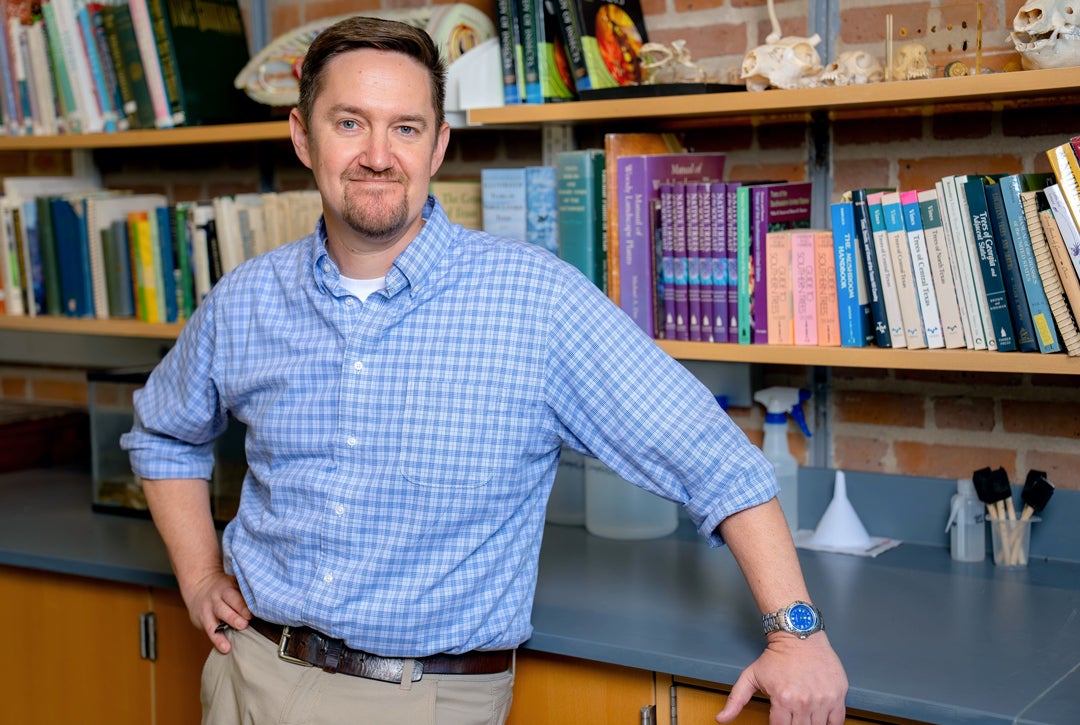
As a biologist, Scott Solomon’s career has taken him to the rainforests of Central and South America, studying the complex societies of ants. Now he’s imagining living environments even further afield, shifting his focus from Earth-bound to extraterrestrial, asking big questions about how humans will evolve after we leave our home planet in his new book, “Becoming Martian: How Living in Space Will Change Our Bodies and Minds.” It’s a line of inquiry that has allowed Solomon to collaborate with researchers, astronauts and even a Rice alumna who pioneered space medicine — connections that have shaped the science behind the story.
What first got you thinking about humans living on Mars — not just getting there, but staying there?
I got interested in this topic once it became clear that people were serious about the idea of living beyond Earth. As an evolutionary biologist, my question was: What if they are successful? Do we really understand what the consequences of space settlement would be for the settlers? And not just the first people who travel to Mars (or anywhere in space, including the moon), but their children, grandchildren and later generations.
When people imagine life on Mars, they often picture futuristic technology. You focus instead on the human body. What changes to our bodies do you think would surprise readers the most?
Being in space has profound effects on the human body. Lower gravity and higher radiation are two of the biggest challenges. Astronauts lose muscle tone and bone density the longer they are in space. But one of the more concerning changes is to astronauts’ vision. Body fluids that are normally found mostly in the lower body are redistributed in microgravity, and one of the effects of these fluid shifts is an increase in pressure on the eye. That can cause the sensitive membranes in the eye to buckle and fold, causing vision deterioration.
You write about gravity’s effects on humans as one of the biggest unknowns. Why is partial gravity such a profound question for scientists?
We know a lot about what being in space does to the human body from studying astronauts for the last six decades. But what might be surprising is that we cannot necessarily apply all of what we know to what would happen to people living their entire lives on the moon or Mars. For one thing, most of what we know is based on studies in weightlessness — essentially zero G. But Mars has one-third the gravity of Earth. Is that enough gravity for our muscles and bones to remain strong? Would vision loss continue to be a problem, or is partial gravity enough to retain normal function? We don’t yet know.
If humans were to live on Mars for generations, do you think we would eventually become physically different from people on Earth? What might that look like?
Assuming that it is possible to reproduce in space — another unknown — future generations born on Mars are likely to become increasingly different from people on Earth. We know that plants and animals on islands diverge from their relatives on the mainland or on other islands. Future generations of people on Mars might become shorter, as commonly happens to island animals. Bone density loss could make childbirth more dangerous for Martian mothers, so C-section births could become the norm. If so, the head would no longer be constrained to fit through the birth canal. That could lead to the evolution of big-headed Martians, not unlike some depictions from science fiction.
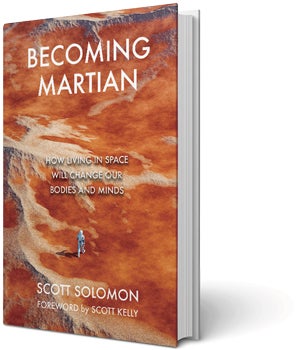
How Living in Space Will Change
Our Bodies and Minds
Scott Solomon
The MIT Press, 2026
Beyond the science, your book raises ethical questions about settling another planet. What conversations do you hope readers start having after reading “Becoming Martian”?
In this book I wanted to help start what I think are very important conversations about the reality of what it would be like to live in space. There are so many questions that we don’t yet have answers to, like whether a child born on the moon or Mars could ever come back to Earth, or whether genetic engineering would be necessary to help people survive in the conditions on other worlds. To me, the ethical questions are at least as important as the engineering and biological challenges of getting people to the moon and Mars, and I think we should be addressing them before the first settlers start boarding rockets.
How has being in Houston, so close to the space industry, shaped your work or influenced how you think about the future of human evolution?
Houston is at the heart of humanity’s expansion into space, and it has been since the early days of human space exploration. There were so many ways in which being in Houston — and being at Rice — helped me to research this topic. I sat in on Professor Stephen Bradshaw’s astronomy course. I joined Professor Kirsten Siebach as her team made daily decisions about where to send the Mars Perseverance rover. I’ve been able to get to know people at NASA and at several of the commercial space companies that operate in the area. I got to meet astronauts and watch them train; I also connected with many of the researchers in the field of space medicine, which Houston and the Texas Medical Center in particular are known for. And I went down to South Texas to watch a test launch of SpaceX’s Starship rocket, which is designed to carry people and supplies to Mars.
Your book is deeply scientific, but it unfolds in a very narrative, story-driven way. Why was storytelling so important to you?
As an educator and a science communicator, I’ve seen how stories help people to connect with a topic and make it meaningful. I wanted to show not just what we know about how living in space will change our bodies and minds, but how we know it. I wanted to take readers to the places where the research is happening, to meet the researchers who are doing this work and to tell their stories. Science is a human endeavor, and it’s one that can sometimes seem mysterious or distant, but when you get a glimpse into the lives of researchers and see their work firsthand, it helps you not only to understand it but also to appreciate and value it. And I think that’s really important.
Scott Solomon is a teaching professor of biosciences in Rice’s Wiess School of Natural Sciences.
From the Spring 2026 issue of Rice Magazine