
Our Artemis Era
As NASA’s Artemis program sets its sights on the moon and beyond, Rice faculty and alumni are part of a partnership spanning six decades.
By Rachel Leeson
In 1969, as NASA prepared for Apollo 11 to land on the surface of the moon, its astronauts faced a terrifying unknown: What would happen when their boots hit the lunar surface? Would they sink into deep, treacherous dunes of cosmic dust, piled up like sand in a desert, or would they merely disturb a thin layer of dust, like a house in need of sweeping?
To prepare for this momentous “one small step,” the spacecraft included a space-age dust sensor developed by Rice space science professor Brian O’Brien.
“There was so much we didn’t know about the moon,” says Patricia Reiff, a professor of physics and astronomy who worked on the Apollo 13 and 14 missions. “It seems perhaps silly to think about it today, but in 1969, we were genuinely worried about the amount of dust on the moon.”
In a sense, the Apollo program unofficially launched at Rice in 1962, with John F. Kennedy’s famous moonshot speech delivered at Rice Stadium. And Rice’s space science program, established in 1963, has made countless contributions to the agency over the decades in the form of both research and experts.
Indeed, the first Rice-NASA collaboration started in 1959, just months after NASA was founded. Since then, Rice faculty, staff, students and alumni have worked on Cassini, Galileo, the Mars Global Surveyor and the Pioneer Venus Orbiter. They have analyzed data from Voyager missions, done space weather forecasting and studied what it takes to make a planet habitable — as well as what extraterrestrial living might do to a human body. Reiff, who runs Rice Space Science Alumni, estimates that Rice students and professors have been involved in at least 50 NASA missions to date. That includes the latest Artemis missions, which have brought the wonder of space exploration back into the foreground of popular consciousness.
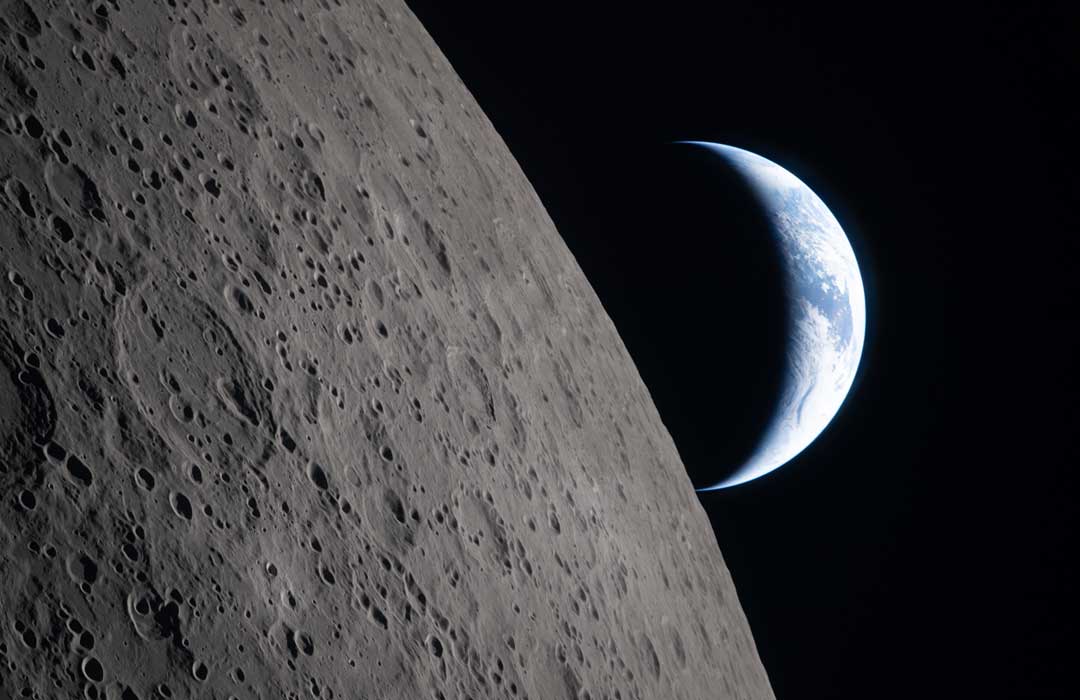
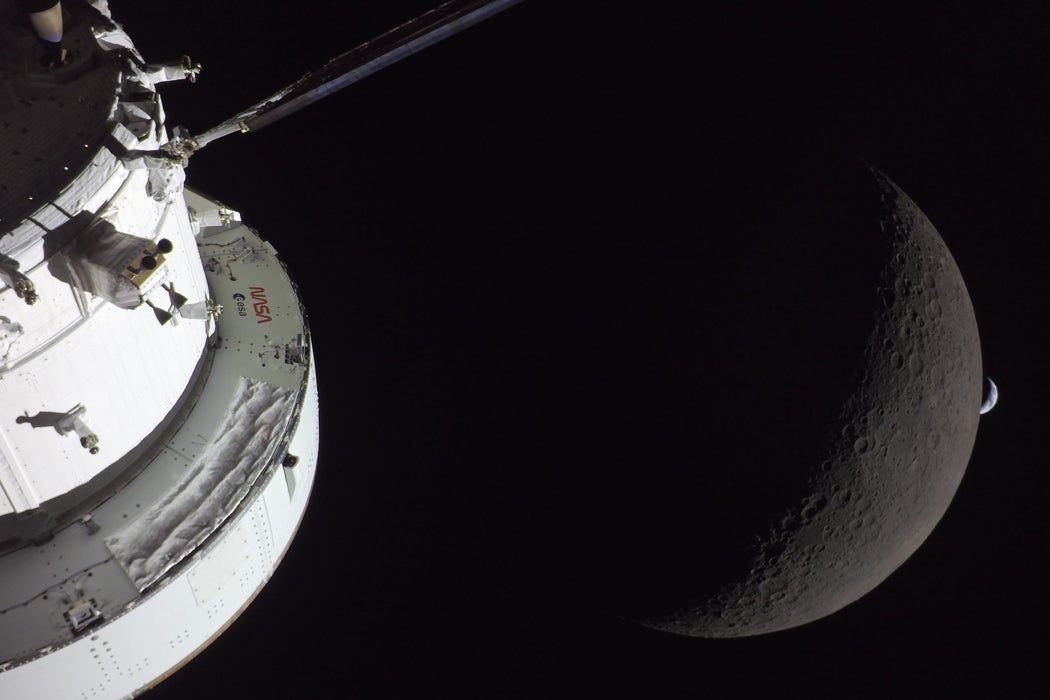
For 10 days in April, Artemis II captured the public’s imagination as four astronauts flew around the moon, venturing farther into space than any humans before them. Watched by millions around the world, the mission rekindled the wonder of human spaceflight and opened a new chapter in lunar exploration.
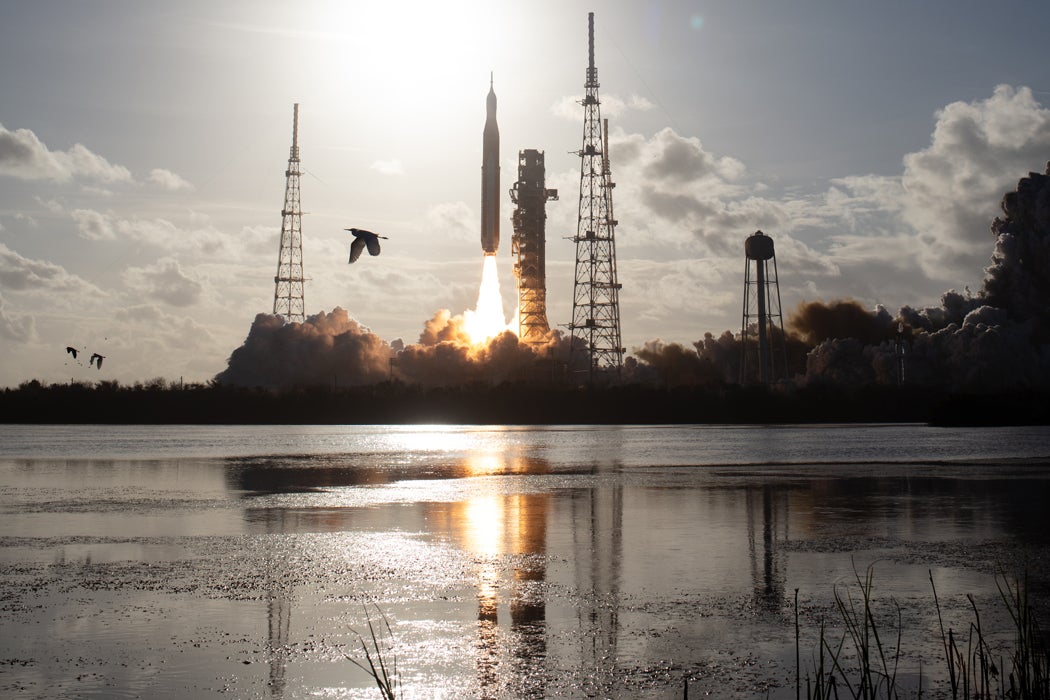
This followed the quieter Artemis I launch in 2022, which sent an unmanned spacecraft around the moon to test NASA’s mega moon rocket, the Space Launch System. Artemis III, planned for 2027, will test commercial landers in low Earth orbit in preparation for Artemis IV the following year. In 2028, Artemis IV’s four astronauts will fly to the moon’s orbit, transfer to a commercial lunar lander and land on the moon’s surface before returning to Earth. Finally, Artemis V will also be a lunar surface mission, with plans to launch new lunar missions annually after it returns. Each planned Artemis mission is building toward exploring the moon’s surface and beyond — a preparation for future missions that could bring humans to the surface of Mars.
“What we see with Artemis is the steady and continuous progress that is made,” says David Alexander, director of the Rice Space Institute. “It is a series of ‘small steps’ that allow us to, eventually, do incredible things.”
The contrast between the Apollo missions in the 1960s and the ongoing Artemis project certainly shows the giant technological leap mankind has made since the first moon landing. (We are, thankfully, no longer worried about moon dust.) But one thing has remained constant: Rice faculty and alumni are just as involved with Artemis as they were a half-century ago during the first moonshot.
That includes Rice alumni working at NASA in everything from communications to engineering; as well as newer initiatives like the Rice Space Institute, leading space research and building collaborations both locally and globally; and the new Rice-led Center for Space Technologies, providing training for people in the space industry. The success of the Artemis missions is built upon a mosaic of experts, technologies and celestial ambitions. These are just a few of the Owls who are part of that project, working to take us to the moon and beyond.
Patricia Reiff and David Alexander are professors of physics and astronomy in the Wiess School of Natural Sciences at Rice.
The Mission Monitor
By Chris Stipes
Quyen Tran Jones ’93 | Aeronautical Engineer
As the Artemis II mission marked a historic return to crewed lunar flight, a Rice alumna helped monitor the spacecraft in real time from the ground.
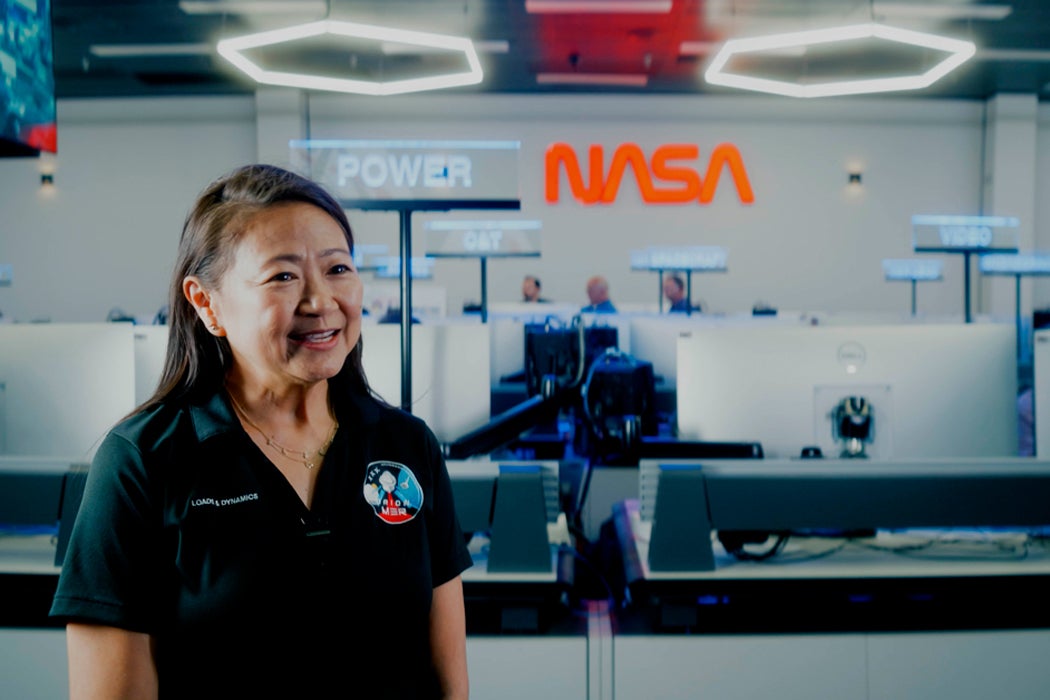
Quyen Tran Jones, who has a bachelor’s degree in mechanical engineering from Rice, is part of the team working inside NASA’s mission control complex at the Johnson Space Center built to host the Orion Mission Evaluation Room.
From her console, Jones tracked the forces acting on the Orion spacecraft during flight — everything from air pressure to rocket thrust — ensuring the vehicle performs as expected in the harsh environment of space.
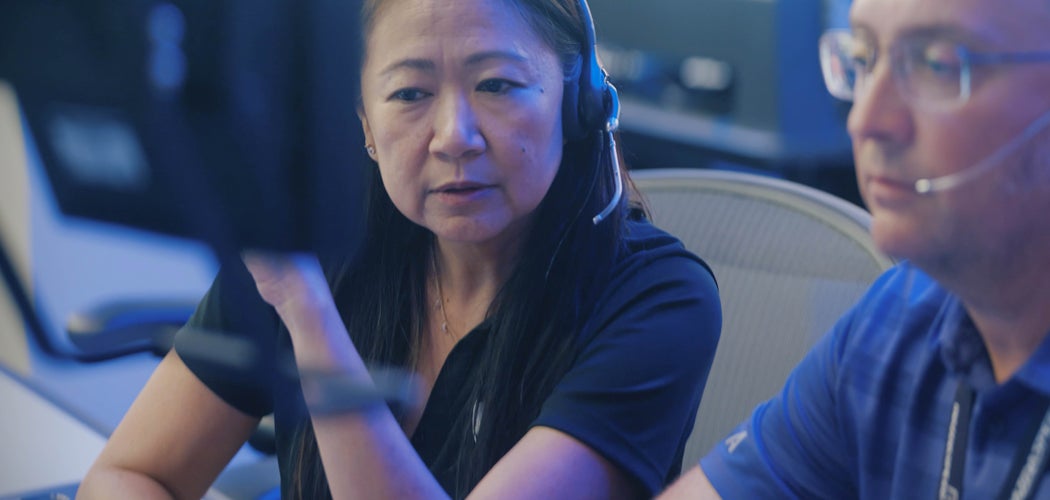
“We saw a really good launch, everything went according to plan,” Jones said in a NASA interview. “We have to check the solar arrays, that when they deploy they don’t go under any unexpected loading. And they didn’t. They deployed beautifully.”
Inside the Mission Evaluation Room, dozens of engineers analyze real-time data from Orion, working in close coordination with flight controllers in mission control’s White Flight Control Room, who operate and send commands to the spacecraft. The evaluation room provides critical engineering insight, helping assess performance and responding quickly to any unexpected behavior.
Jones’ work focuses on mechanisms’ thermal protection systems and loads and dynamics — disciplines essential to ensuring the spacecraft can withstand the intense forces encountered during launch, deep space travel and reentry.
“Once we get the in-flight data and can compare and confirm some of our assumptions that were based on testing and textbooks, and confirm that in space, I’m excited for that,” she said. “And I’m excited to see humans go around the moon.”
The Descent Designer
By Alex Becker
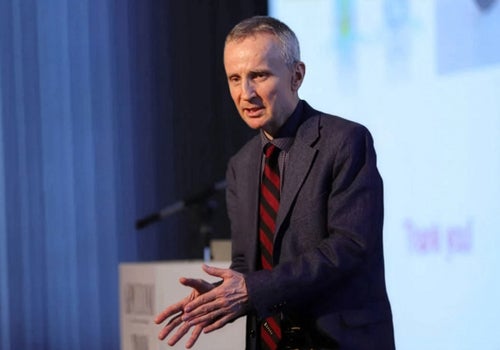
Tayfun E. Tezduyar | Professor of Mechanical Engineering
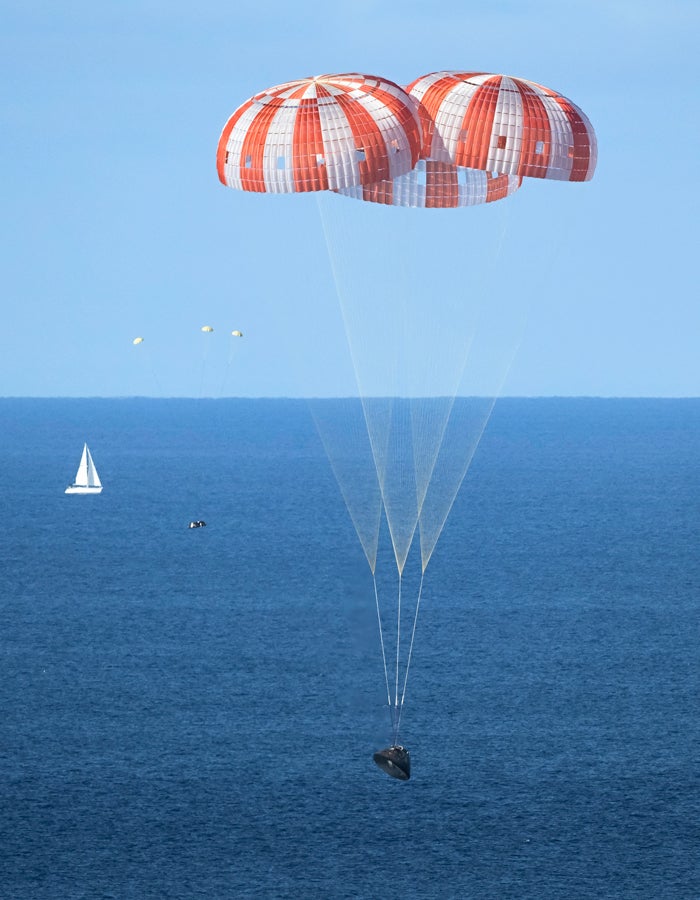
When NASA’s Orion capsule splashed down in the Pacific Ocean, completing a successful Artemis II mission milestone, a critical piece of the spacecraft’s safe return traced back to research at Rice.
The capsule’s three-parachute system — responsible for slowing Orion’s descent and ensuring a safe landing — was developed with key computational parachute fluid-structure interaction analysis from Tayfun E. Tezduyar, the James F. Barbour Professor of Mechanical Engineering in the George R. Brown School of Engineering and Computing at Rice, and longtime collaborator Kenji Takizawa of Waseda University, working alongside NASA’s Johnson Space Center. Their team was the only group providing computational FSI analysis for the parachute.
Completed in 2013, that modeling proved essential to solving one of the most complex challenges in spacecraft parachute design: how to ensure the parachute is both large enough to slow the spacecraft to a safe landing speed and free from descent speed oscillations associated with shape instabilities.
“For a given spacecraft weight, the parachute must generate enough aerodynamic drag to achieve a safe landing speed,” says Tezduyar. “But just as important, it has to maintain a stable shape. If the drag fluctuates, so does the descent speed — and that can compromise a safe landing.”
While the aerodynamics of the parachute depend on its shape, the deformation and shape of the parachute fabric structure depend on the aerodynamic forces. “You cannot separate the aerodynamics from the structural dynamics,” Tezduyar says.
This two-way dependence, known as FSI, requires a reliable parachute aerodynamic analysis to actually be a parachute FSI analysis. That, together with the fact that the two-way dependence is even stronger for large parachutes, was one of the many challenges in the computational analysis.
Early designs based on scaled-up Apollo-era parachutes revealed what was at stake: NASA drop tests showed large fluctuations in parachute diameter — a sign of shape instabilities that could lead to unsafe landings. Using high-fidelity parachute FSI simulations conducted at Rice, Tezduyar and Takizawa’s team confirmed the issue and helped guide the design toward a more stable configuration.
The final parachute system, refined through a combination of NASA drop tests and Rice’s computational FSI analysis, eliminated those fluctuations, producing a stable descent profile suitable for human spaceflight.
And as each physical drop test was costly and dependent on weather conditions, the Rice team’s simulations allowed NASA engineers to reduce development costs and timelines by evaluating designs virtually before committing to real-world testing.
“We ran many, many simulations to test different canopy shapes and suspension-line configurations,” Tezduyar says. “Each one required significant computational resources and time, but it allowed us to narrow down the most promising designs and accelerate the overall design process.”
More than a decade later, their work played a quiet but crucial role in one of NASA’s most triumphant achievements.
The Mission Messenger
By Silvia Cernea Clark
Sarah Frazier ’15 | Communications Manager
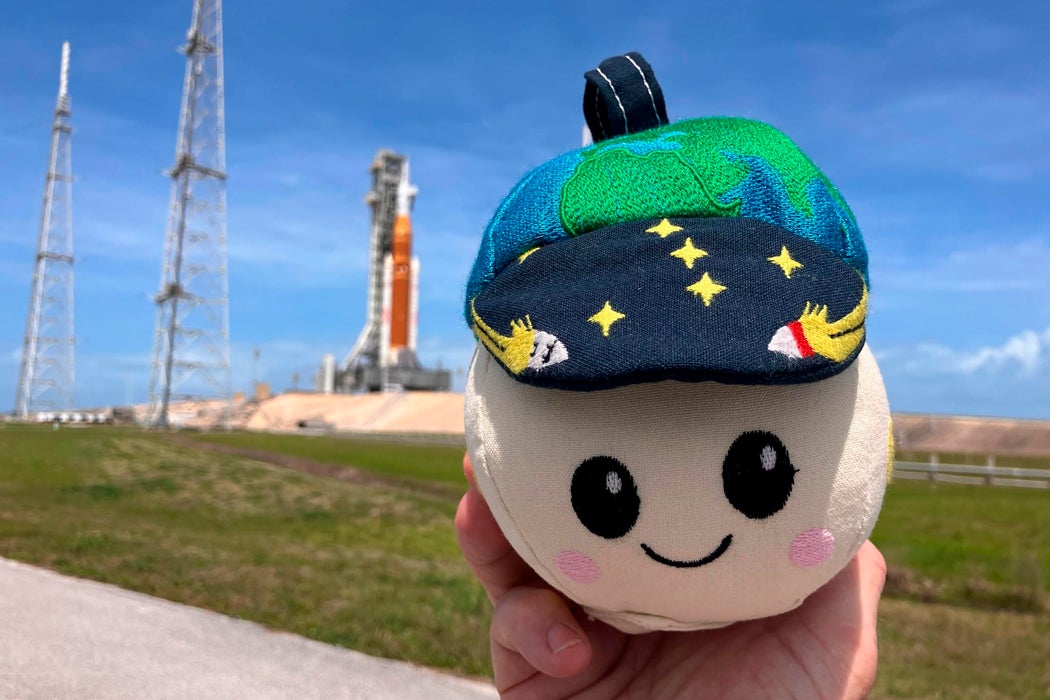
As soon as the Orion spacecraft reached zero gravity, a moon-shaped plushie named Rise began to float around the capsule, letting the astronauts know they had reached a new phase of flight. Sporting an Earth cap and plucky smile, Rise served as the official zero-gravity indicator for Artemis II. But it was also there to aid with another critical objective of the mission — storytelling for the millions following along back on Earth.
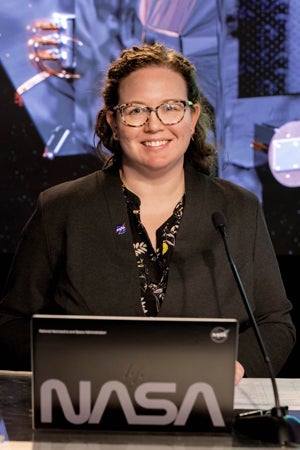
Rice alumna Sarah Frazier, who manages communications for the heliophysics and planetary science missions run out of NASA’s Goddard Space Flight Center in Maryland, helped give Rise a voice, orchestrating a social media takeover from its adorable point of view. Rise’s posts were a way to combine, as she puts it, “the moon joy that people were feeling” with “information about mission goals, what the astronauts were doing and why it all matters.”
Science and storytelling have been closely intertwined for Frazier ever since her time at Rice. She arrived intending to study engineering but then realized that what really drew her were “the fundamental questions about how the universe works.” Physics and astronomy answered that curiosity. However, a stint with undergraduate research revealed that writing was the stronger calling. “Getting all of that hands-on experience at Rice was really helpful for figuring out what I really liked,” Frazier says.
While at Rice, Frazier wrote for The Thresher and did a science-writing-focused internship at NASA. During a physics conference she attended, Frazier learned about science writing as a field in its own right and knew that it was something she wanted to pursue. “It combined that fascination that I had for physics with the storytelling part that I really liked,” Frazier says.
On a typical day, Frazier is a connecter and orchestrator, meeting with mission teams and coordinating the writers, photographers, social media specialists and outreach teams responsible for sharing knowledge with the public. She still gets to pitch in on the writing during “all-hands-on-deck times,” like during Artemis II. Though the way she helps shape stories has changed, the motivation driving her has remained constant: Frazier is passionate about explaining how probing space benefits people in ways both immediate and unexpected — or in her words, “why we’re doing all this cool, adventurous stuff.” The shared sense of wonder that outer space evokes, she says, reminds us we are all “a part of the same cosmic dance.”
The Systems Architect
By Silvia Cernea Clark
Wyeth McKinley ’23 | Flight Controller/Crew Instructor
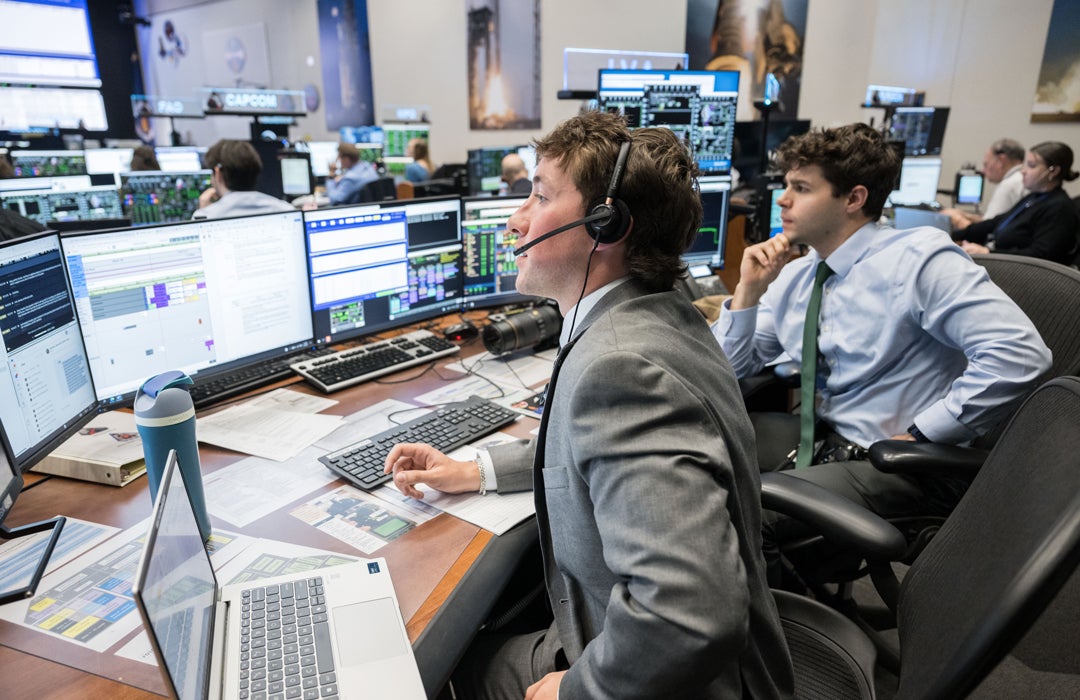
During spaceflight, Orion is more than a means to reach a destination — it is a home, a laboratory and a workplace. Astronauts’ every movement through the capsule has been charted and rehearsed in advance, from eating, sleeping and putting on a spacesuit to responding to the unexpected. The crew spends months imprinting every nook and cranny of the capsule into their memory so that, once in orbit, they can be as efficient as possible.
As a NASA flight controller responsible for Orion’s intravehicular activities, Rice alumnus Wyeth McKinley works on the systems astronauts interact with inside the spacecraft and the procedures that guide them through each task. Some of his days are spent writing detailed instructions; others unfold inside full-scale mockups of Orion, teaching crews how to operate a particular system or running simulations and troubleshooting problem scenarios.
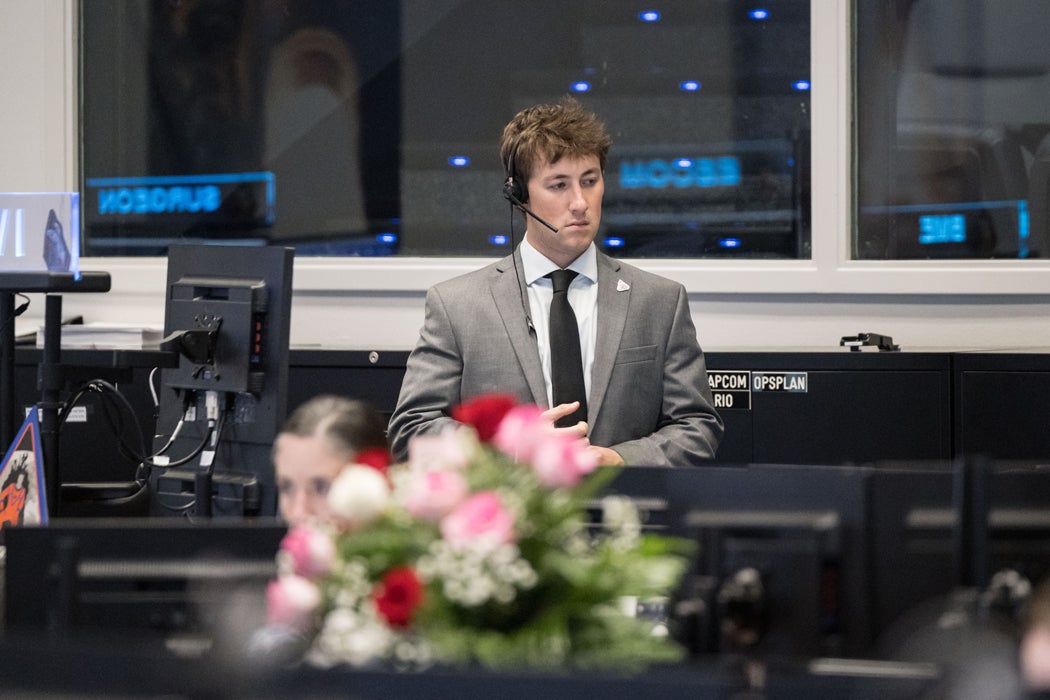
As he reflects on the path that brought him to NASA, he says, “It’s really obvious that I’ve been obsessed with space since I could talk.” But the idea to pursue that fascination as a career is something that took shape later, “by virtue of coming to Rice and to Houston.” The opportunities at the university, from engineering projects to an internship through NASA’s Pathways Internship Program, gradually made the path visible. The residential college system also played a role: Building relationships and learning to work with others turned out to be preparation for mission control in ways he had not anticipated. “Putting together a large party is very similar to putting together a large mission,” McKinley says.
For anyone wondering whether there is a place for them in the next era of space exploration, McKinley says there are many ways to get involved.
“We are trying to go back to the moon,” he says. “And we need all the help we can get.”
The Docking Designer
By Silvia Cernea Clark
Will Coben ’22 | Flight Controller
Orion, the spacecraft that took a crew of four deeper into outer space than any human had ever ventured before, is a technological marvel. One of its critical capabilities is docking, a complex procedure that allows it to connect to other spacecraft, like space stations, lunar landers and propulsion systems. Hovering in orbit, these massive machines have to find one another, align with extraordinary precision, gently make contact and create an airtight seal.
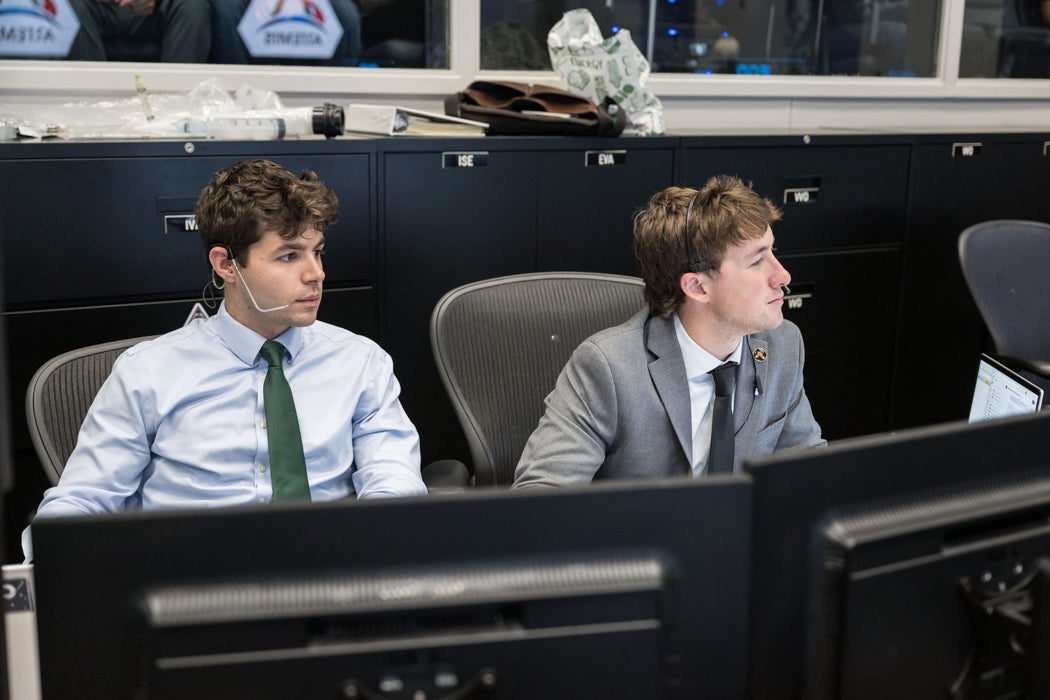
Behind the minutes-long choreography are countless hours of planning, testing and crew training. Will Coben, a Rice mechanical engineering alumnus and a flight controller at NASA’s Johnson Space Center, is one of the experts ensuring that docking unfolds like clockwork.
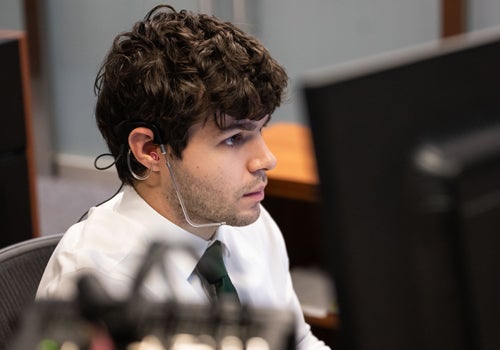
Coben develops the displays, commands and procedures astronauts use to operate systems like those involved with docking, jettison events and separation, as well as solar array positioning and control. A self-described “flight control nerd,” the challenge of the job appeals to him as much as space itself. However, the passion that now drives him “didn’t fall in my lap” — it was something he discovered by “trying things.”
“When I look back at my Rice experience, I think a lot about the extracurriculars like Rice Eclipse (the university’s rocketry club) and working at the Oshman Engineering Design Kitchen as a lab tech,” Coben says.
Coben’s penchant for “teamwork problem solving” found a home at NASA, and he says Artemis II reminded him why he was drawn to it in the first place: It was not so much about space, but about the desire to be a part of an effort to “accomplish something seemingly impossible.”
“Pretty much everyone was rooting for Artemis II to be successful and was motivated by it,” Coben says. “Seeing something that is a unifying force in the world … really served as a motivating factor for me.”
The Future of Space Explorers
By Alex Becker
When astronauts return to the moon through NASA’s Artemis program, they will need intuitive, reliable interfaces that help them navigate unfamiliar terrain, monitor mission-critical data and make quick decisions in high-pressure environments.
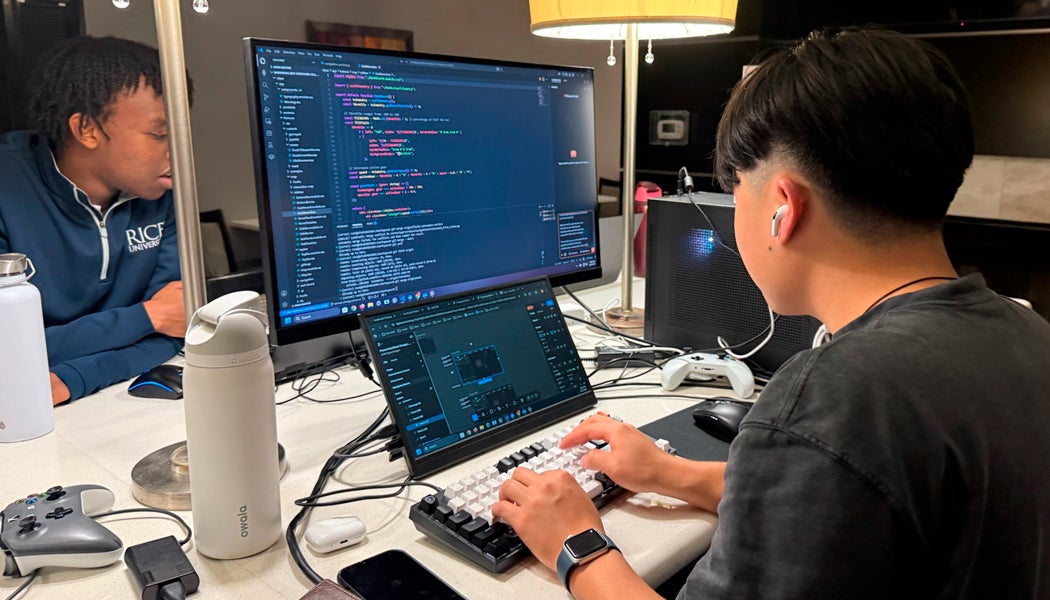
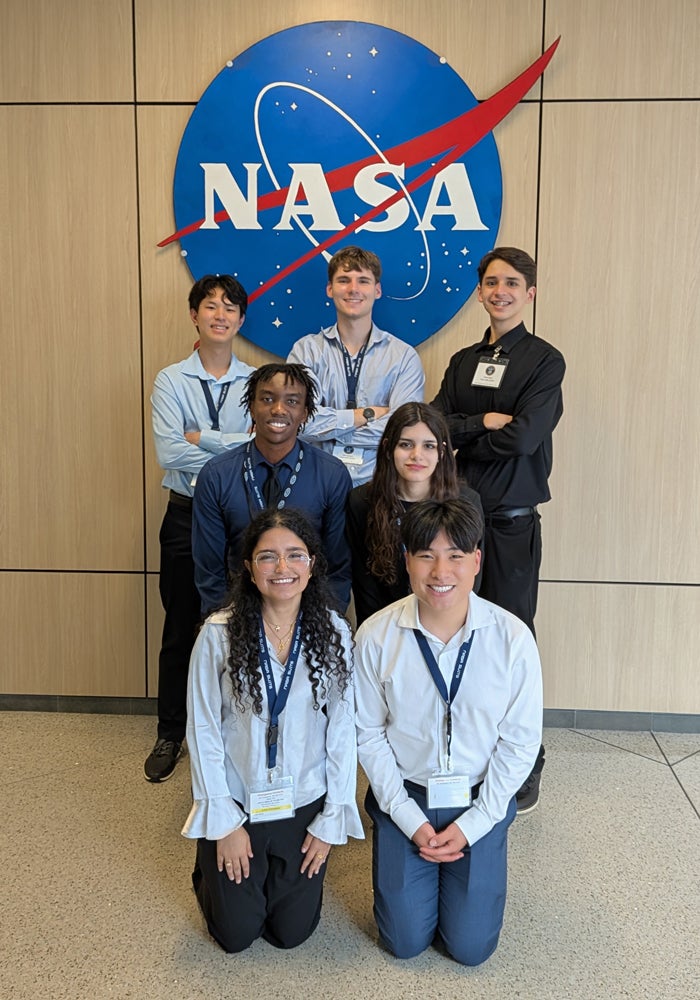
Rice students are now helping to design that future. Members of the Rice Augmented Reality/Virtual Reality Club participated in NASA SUITS, or Spacesuit User Interface Technologies for Students, a national software design challenge that invites college students to develop interface solutions for future human spaceflight. Teams from universities across the country submit concepts to NASA in the fall, with only a handful selected to develop prototypes over the course of the year. This marks the third consecutive year that the Rice team made the cut, traveling to NASA’s Johnson Space Center in May to test its system with NASA engineers and present its work.
“NASA SUITS gave us the chance to work on a real engineering challenge tied directly to the future of space exploration,” says Israel Cantu ’28, a computer science major and one of the team leads. “It pushed us to think not just about what a system can do, but how an astronaut or rover operator would actually use it in a mission environment.”
This year, Team OWL SUITS was assigned to develop a pressurized rover interface for a simulated lunar mission. In the scenario, an unmanned rover has gone offline at a known location on the moon. The Rice team, working closely with faculty mentor Robert LiKamWa, designed software to help an operator navigate a pressurized rover to locate and approach the disabled vehicle using autonomous path planning, real-time obstacle avoidance and clear displays of mission data such as crew vitals and vehicle resource status.
One of the central design challenges was reducing cognitive load. During a tour of NASA’s Mission Control Center, the team observed operators managing complex, multi-monitor interfaces in real time.
“When someone is managing a high-stakes mission with multiple streams of information coming in at once, clarity is a safety requirement,” Cantu says. “That became one of our guiding principles: How do we give the operator the information they need without overwhelming them?”
During the team’s first formal testing session, their NASA mentor Alex Kanelakos evaluated the interface and provided feedback. The students then worked through the night to prioritize and implement changes before the second test.
“This project brought together so many parts of what we study at Rice — computer science, design, autonomy, human factors and teamwork,” Cantu says. “Being able to test our work at Johnson Space Center and receive feedback from NASA engineers made the experience incredibly meaningful.”
Robert LiKamWa is associate professor of electrical and computer engineering in the George R. Brown School of Engineering and Computing at Rice.
Rice: NASA’s Landlord?
By Sarah Rufca Nielsen
In the early 1960s, when NASA was looking for a home for its new Manned Spacecraft Center, Houston had plenty to offer: water access, industry, mild weather and a research university eager to be part of the space age. It also had friends in high places, including construction magnate George R. Brown ’20, then chair of Rice’s governing board, and his former Rice roommate, Congressman Albert Thomas ’20, chair of the powerful House Appropriations subcommittee that oversaw NASA’s budget.
Brown first arranged for Humble Oil and Refining Co. to transfer just over 1,000 acres of Clear Lake cow pasture to Rice. When NASA announced in 1961 that its center would be built in Houston, the Clear Lake tract helped seal the deal. Rice quickly conveyed the 1,020 acres to the federal government — the deed language points to a nominal sale, reportedly $20 total — something of a civic gift with paperwork attached.
When NASA decided it needed more land in the area, Rice acquired another 678 acres from Humble Oil, trading it for a similarly sized piece of land closer to downtown Houston. This time the university sold its land to NASA for a significantly heftier price tag: $1.2 million.
So yes, Rice helped turn Houston into Space City. But the path from cow pasture to Mission Control was not exactly a straight shot. It involved civic ambition, institutional leverage, a land swap and some classic Washington horse-trading.
And that persistent rumor that Rice still owns the land and leases it to NASA? Not true. Still, enough Owls believe the story to keep it happily orbiting.
From the Fall 2026 issue of Rice Magazine