
Historian John Boles on “Grand Papa Jefferson”
Rice Professor Emeritus John Boles explores Jefferson’s role as a father and grandfather to reveal a more personal side of the third president.
By Deverly Pérez
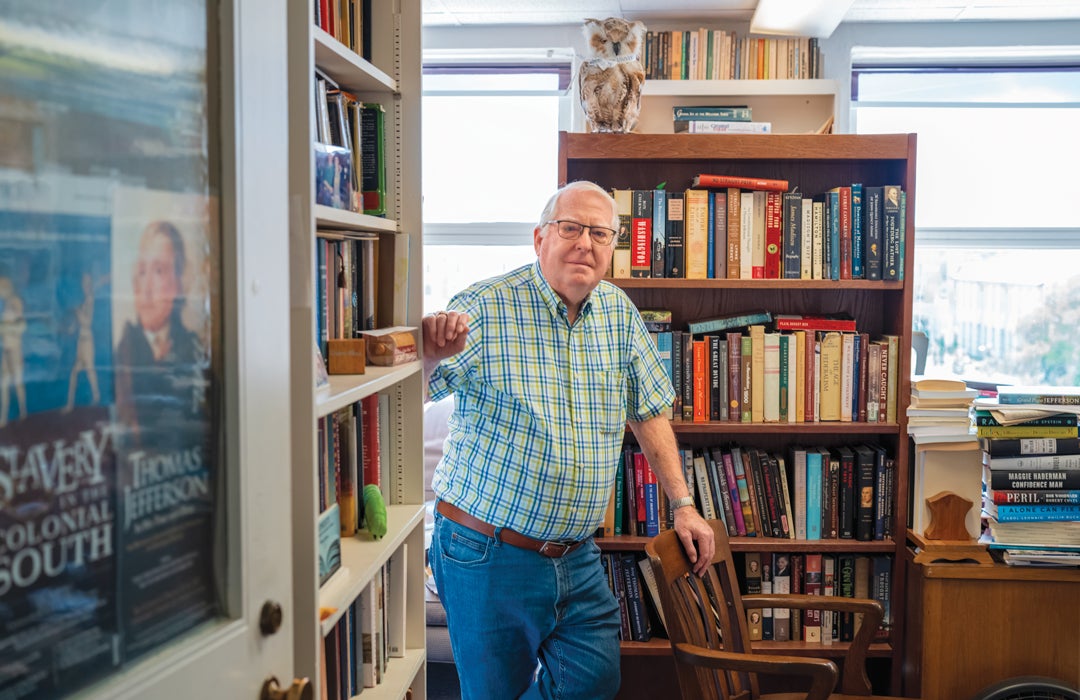
In his 2018 biography “Jefferson: Architect of American Liberty,” Rice Professor Emeritus John Boles ’65 argued that Thomas Jefferson could only be understood by considering the full complexity of his life and times. His new book, “Grand Papa Jefferson: An American President and His Grandchildren,” narrows the lens, drawing on family correspondence to explore Jefferson’s role as a father and grandfather and reveal a more personal side of the third president. Speaking with Rice Magazine, Boles reflects once more on what this intimate perspective adds to our understanding of Jefferson’s life, legacy and contradictions.
What made you feel that there was another important Jefferson story to tell?
Jefferson lived a long and accomplished life, so historians have written books on many aspects of it beyond his political roles; there are books on Jefferson and music, architecture, law and nature. In reading the corpus of his correspondence, I noticed he wrote hundreds of letters to his daughters and 12 grandchildren and received many from them, but no one had analyzed them to understand Jefferson in his role as father and grandfather. In these letters he is unguarded and personal, revealing a warm and even humorous side seldom recognized. The letters also reveal much about family life at the time, including the frequency of disease and death and its impact on parenting. As a grandfather myself, I enjoyed reading about how he balanced family and career, how he mentored his children and grandchildren, and how they related to him.
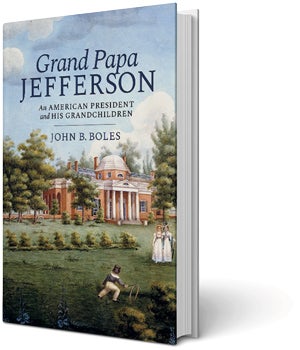
John B. Boles ’65
Mercer University Press, 2026
How did focusing on Jefferson’s domestic life change your understanding of him?
I argued in my biography that Jefferson needed to be seen holistically, in the context of his time and place, and as someone who grew and changed over the course of his life. This book represents my trying to do that with another aspect of his life. Very few people of his status wrote, kept and received so many personal letters, so his correspondence offers an unusual window into family life and parenting roles in the late 18th and early 19th centuries. It offers insight into gender roles, companionate marriage and the different educational expectations for males and females. The letters also reveal the personalities and interests of the various children.
How did you navigate portraying Jefferson’s family relationships without losing sight of the inequalities created by slavery?
Part of being a historian is understanding that people must be interpreted within their own context; being a slaveholder when slavery was a legal and widely accepted institution did not mean a person was devoid of morals or incapable of love. Jefferson was philosophically opposed to slavery but simultaneously caught up in the system. Economic and legal obstacles made the personal freeing of enslaved people difficult.
Jefferson had in effect two families, one legal and the other a kind of extra-legal shadow family. Most scholars today accept that he had a long-term relationship with Sally Hemings and assume a degree of mutual affection between them. In a different time, Jefferson might have married her, but legal and personal constraints made that impossible.
Jefferson treated Sally, her children and their extended family differently [from his other slaves]; they were not sent to work in the fields and monopolized the skilled positions at Monticello. His loving relationship with his white grandchildren was visible to visitors while his relationship with his children by Sally was never revealed. This was one of the tragedies of life in a slaveholding society, and we may be critical of Jefferson for not transcending the mores of his world.
How did the absence of a comparable written record for Jefferson’s children with Sally Hemings shape your approach to the book?
What attracted me was the correspondence between Jefferson and his white children and grandchildren; these letters offer insight into their relationship and a glimpse into their lives. But what about the Black children, for whom no comparable correspondence exists? Their relationship to Jefferson cannot be revealed in the same way. Any discussion of the two sets of children highlights the inequalities involved.
It would not be right to ignore the Black children simply because we cannot know as much about them. The difference between what we can know is a consequence of slavery in Jefferson’s life. He favored them and treated them differently from other enslaved workers, but he never flouted their biological ties. We should not imagine unremitting animosity, nor minimize the discrepancies between their lives and those of his white grandchildren. The contradictions are tragic.
Was there a moment in the research that surprised you or changed the emotional tone of the project for you?
I most enjoyed the letters from Jefferson’s granddaughters describing their relationships with him at Poplar Forest, his retreat about 90 miles from Monticello. There, he could apparently be more open about his feelings for his two sons by Sally, who worked there under the direction of Sally’s uncle and Jefferson’s favorite enslaved carpenter, John Hemings.
After spending decades studying Jefferson from so many angles, did writing this book change the way you think about his legacy?
Jefferson’s legacy has changed drastically over the 200 years since he died. Over the past half-century, his ownership of slaves has shaped many people’s attitude toward him. I do not see him today as I did in 1965, when I went to graduate school to study him. He now appears more complex, a man of contradictions and moral imperfections. His life as a slaveholder was tragic for the people he legally owned, for himself and for our nation, even though he articulated our highest aspirations more elegantly than anyone else. In many ways, Jefferson embodies the noble promises and the tragic imperfections in our nation’s history.
John Boles is the William P. Hobby Professor Emeritus of History at Rice.
From the Fall 2026 issue of Rice Magazine