
A Greener Game Plan
Houston’s World Cup spotlight became a catalyst for greener public spaces and smarter planning.
By Sarah Rufca Nielsen, with reporting from Avery Franklin and Rachel Leeson
As Houston welcomed the world for the FIFA World Cup 2026, Rice helped turn a global sporting event into a living laboratory for sustainability.
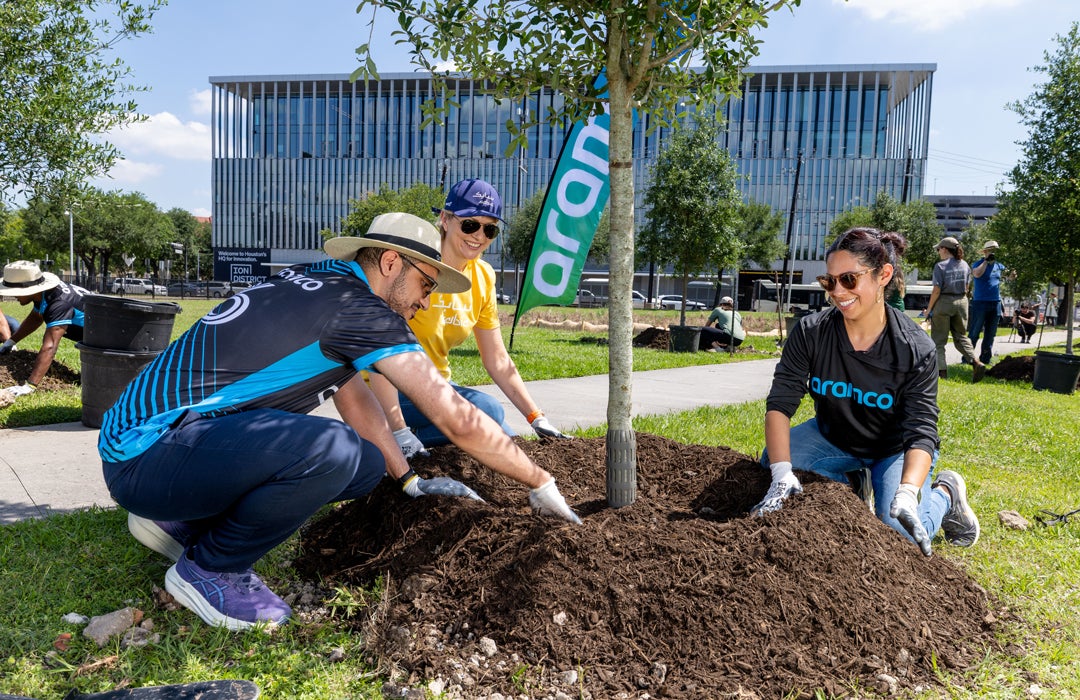
The effort took root in May, when dozens of new trees were planted throughout the Ion District, including near the Ion Building, Greentown Labs and the adjacent Houston METRO station. The planting supports the Houston Green Corridor, a 14-mile network incorporating trails, transit, public spaces, native plantings, shade structures, water access and bike-support amenities linking the city’s major World Cup venues from East Downtown to Houston Stadium.
The Green Corridor initiative also made a stop on Rice’s oak-lined campus through the Rice-FIFA Sustainable Ecologies Installation, a temporary public-facing exhibit sited within the university’s oak grove near Entrance 1. Built by students and staff, the installation highlighted the southern live oak, one of Rice’s defining campus features and a powerful symbol of resilience in Houston.
“Many of us walk past oak trees every day without realizing how many organisms rely on them for food, shelter and survival,” says Qihang Li ’27, an architecture graduate student who co-designed and built the “Living Oak Communities” installation. “I hope people leave ‘Living Oak Communities’ with an appreciation for the complexity of the natural world that exists right around them.”
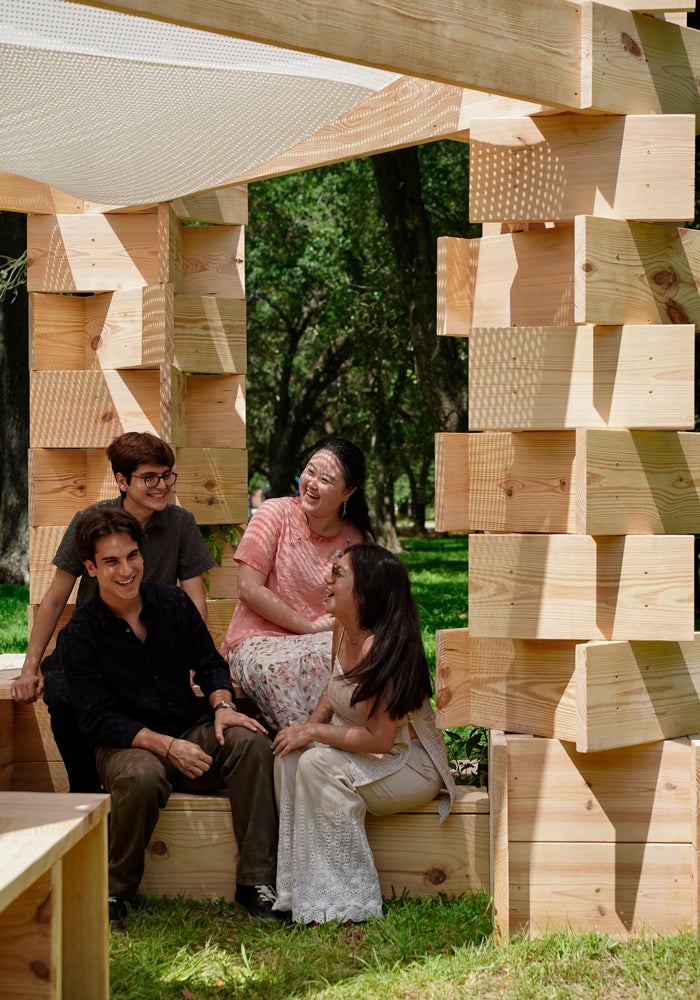
Through a series of interactive design elements offering visitors both seating and shade, the exhibit explores biodiversity, heat mitigation, native plantings and public comfort. Each component serves as a small-scale demonstration of how design can support environmental performance while creating beautiful and welcoming civic spaces.
“I was drawn to the project because it asked the question, ‘How can a structure honor the place it came from?’” says Humaira Shaikh ’28, an architecture undergraduate student. “The installation became a way to translate ideas about Houston’s climate and ecology into something people could physically utilize instead of simply read about.”
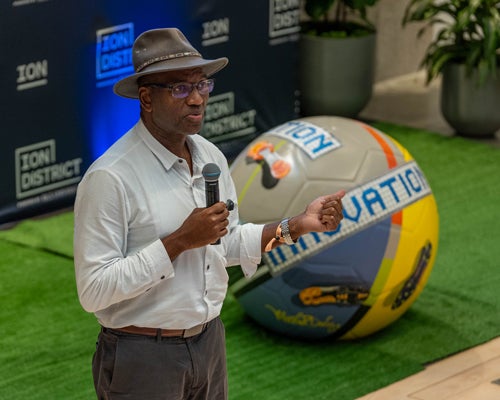
The installation was also part of a broader Rice University Urban Sustainability Projects Portfolio, which brought together initiatives designed to use the World Cup as a platform for international best-practice research, student innovation and data-informed planning. Led by David Abraham, a lecturer in biosciences, its projects examined how cities can activate public spaces, protect biodiversity, reduce waste, measure environmental performance and transform major events into long-term investments.
In June, Rice introduced the portfolio at the Ion as part of a two-day Urban Sustainability Innovation Sprint convened with UNLEASH, a global innovation organization based in Copenhagen, Denmark. The event also included the launch of the Rice World Cup Cities Hack, a sustainability-focused virtual data hackathon that brought together university students nationwide. Teams worked with real-world urban datasets to build data management and visualization solutions, analyzing the sustainability impact of this World Cup on the 11 U.S. host cities.
“For us, the World Cup is not only a global sporting event,” Abraham says. “It is a platform for sustainability communication, economic development and measurable impact. These projects show how universities can help cities think differently about placemaking, ecology, infrastructure and public engagement.”
From the Fall 2026 issue of Rice Magazine