
Everything Everywhere All at Once
With her latest album, Pulitzer Prize-winner Caroline Shaw builds on a career shaped by unlikely inspiration, collaboration and creative risk.
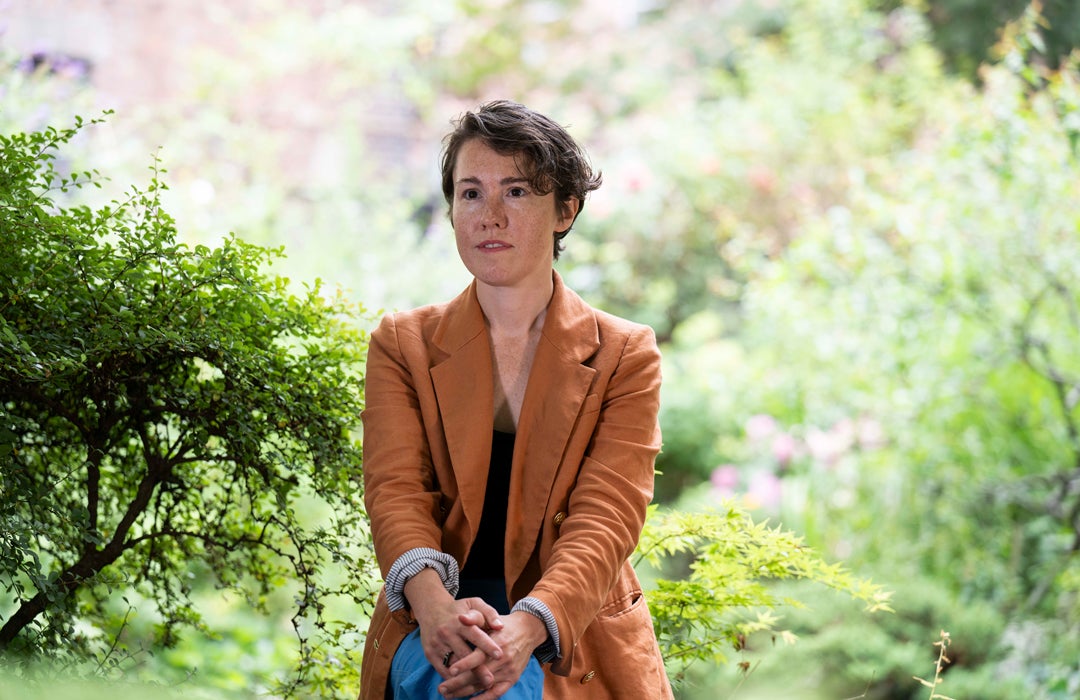
By Jennifer Latson
Caroline Shaw ’04 is a musical alchemist: She can’t stop experimenting. And many of her experiments turn to gold. In 2013, at age 30, Shaw became the youngest-ever recipient of the Pulitzer Prize for Music for her a cappella composition “Partita for 8 Voices.” She’s won five Grammy Awards, and this year she was nominated for a Tony Award for her original score for the Broadway revival of “Death of a Salesman.”
“I love learning something new,” says Shaw, who splits her time between Portland, Oregon, and New York. “I’ll say yes to a project if it’s something I haven’t done before and it will let me grow in some way. It keeps me on my toes.”
Shaw’s passion for experimentation bloomed at Rice, where she studied violin performance with Kathleen Winkler, the Dorothy Richard Starling Professor in Classical Violin at the Shepherd School of Music. Though Shaw has veered from the typical career trajectory of a classical violinist, she attributes much of her success to the technical foundation Winkler helped her build, and to her warmth and generosity as a teacher. “I wouldn’t be able to do what I’ve done in music without her,” Shaw says.
But even as an undergrad, Shaw was intrigued by the many other creative opportunities she encountered at Rice. She joined an a cappella group, tried light opera and dabbled in mainstream popular music. “That was the beginning of my saying ‘yes’ to everything,” she says.
The year she graduated, Shaw received a Thomas J. Watson Fellowship to study Renaissance landscape architecture and formal gardens in Europe for a year. Though fascinated by 17th- and 18th-century aesthetics — particularly gardens — Shaw spent much of the fellowship thinking about music and was inspired to try her hand at composing for string quartet.

“It took me 10 years to finish it, but it got me started on this journey of wanting to make music out of nonmusical things, which is very much what I do now,” she says. These days, composition is at the core of her work, although Shaw still performs regularly as a vocalist and violinist. “I feel very lucky to have a career where I get to play and sing quite a bit, but every day is different. I’ve gotten to dip my toe into a lot of things: a little bit of TV and film and recently theater,” she says. “I like making music that serves a larger project and being collaborative.”
Indeed, she has written and produced for performers across the musical spectrum, including Rosalía, Renée Fleming, Yo-Yo Ma and Nas. Released in May, her latest album, “or, The Whale,” is a collaboration with cellist Andrew Yee that evolved from the duo’s score for the 2022 film, “Moby Dick; or, The Whale.” “Wu Tsang, who’s kind of an experimental artist, was making a very queer silent film about Moby Dick, and when she asked me to write the score, I wanted to do it with Andrew,” Shaw says.
The work includes an adaptation of Shaw’s piece “Really Craft When You,” an avant-garde piece that stitches together interviews of quilters from the 1970s with textured bits of music, forming a musical quilt. The Guardian called it “a haunting, folk-infused evocation of the novel, whale song and all,” noting that “the feeling of artistic intimacy and joy in the music-making is palpable.”
It’s this unalloyed joy that unites Shaw’s varied musical endeavors. “The throughline is that I deeply love music,” she says. “I’m obsessed with it.”
From the Fall 2026 issue of Rice Magazine