
A Different Kind of Game Changer
At FIFA Fan Festival, Rice turned a playground swing into a showcase for decades of university research and alumni-led innovation.
By Andrew Bell
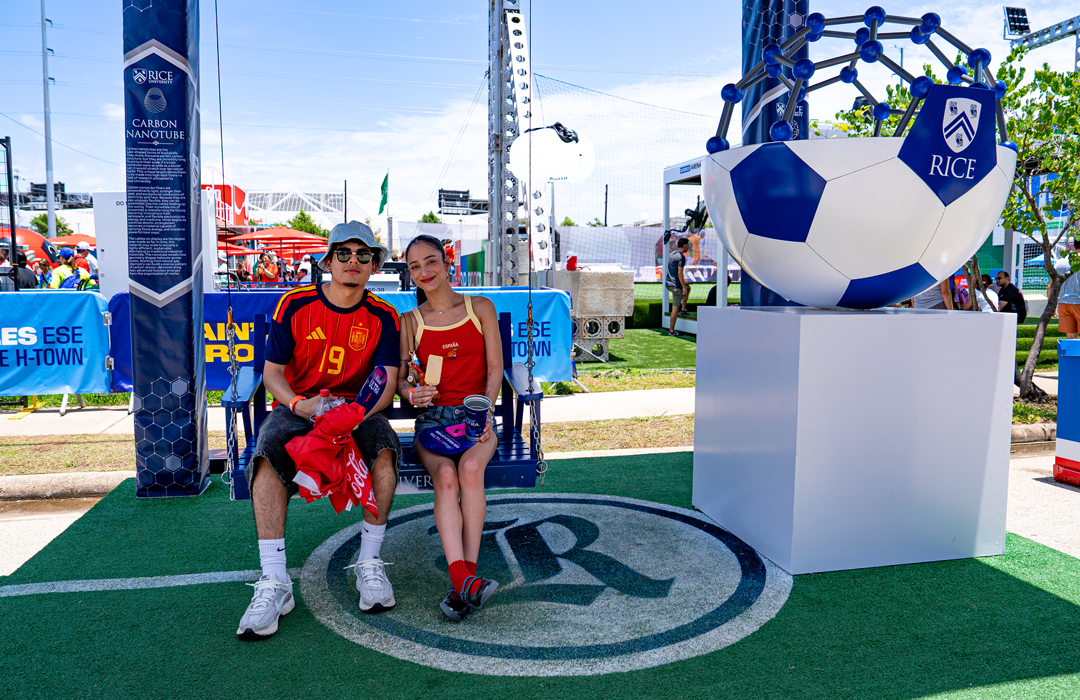
As part of the music, crowds and soccer fever of the FIFA Fan Festival in East Downtown Houston, Rice invited visitors to experience one of its most promising advanced materials firsthand — by taking a ride on a swing.
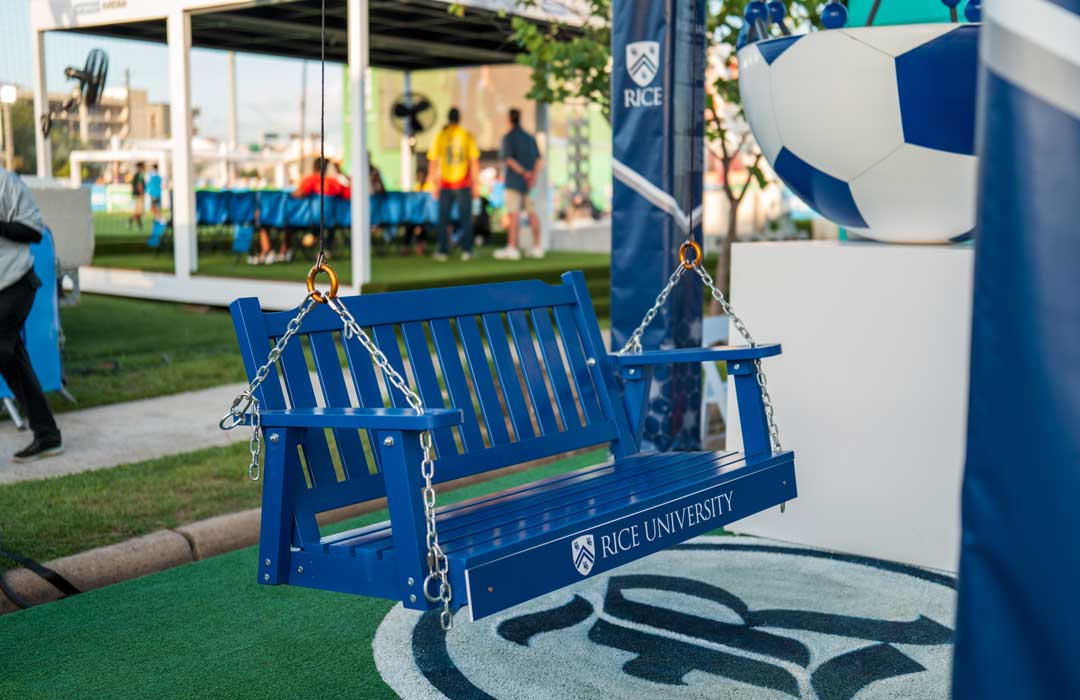
The centerpiece of Rice’s interactive Fan Fest booth was suspended not by the steel chains typically found on playground swings, but instead by cables made from carbon nanotube fibers that were developed through research pioneered at Rice. The two cables collectively weighed less than an ounce yet could support roughly 2,000 pounds.
“We wanted to show something that’s light and flexible and something that can displace steel,” says Matteo Pasquali, the A.J. Hartsook Professor of Chemical and Biomolecular Engineering, professor of chemistry and materials science and nanoengineering, and director of Rice’s Carbon Hub.
The cables were provided by DexMat, a company commercializing the technology that was co-founded by Rice alumni Bryan Guido Hassin ’01, ’02 and Dmitri Tsentalovich ’13, a chemical engineer who helped advance the carbon nanotube fiber technology while working in Pasquali’s lab.
A neighboring display connected the structure of C60 — the infamous buckyball discovered at Rice in 1985 — with the familiar pattern of a soccer ball, highlighting the connection between the world’s most popular sport and one of Rice’s most celebrated scientific discoveries that helped establish the university as a global leader in materials, quantum and nanoscale science.
“The World Cup is an opportunity to bring people together from around the world, and we wanted Rice to be part of that celebration,” says Thomas Killian, dean of Rice’s Wiess School of Natural Sciences and professor of physics and astronomy. “As Houston welcomes visitors from across the globe, it’s a fun way to share a piece of Rice and the spirit of curiosity and discovery that defines our community.”
Students, alumni, faculty and other volunteers staffed the booth for six weeks, answering questions and sharing their Rice experiences with visitors. Recent alumnus and volunteer Nimah Shukkoor ’26 says the exhibit sparked conversations with visitors of all ages.
“We’ve had a lot of kids playing on the swing and people talking to us about what Rice is like,” says Shukkoor, who earned bachelor’s degrees in chemistry and philosophy. “It’s been cool to talk about the different clubs and opportunities Rice has to offer and share some of the things I’ve been lucky enough to experience during my time here.”
The installation placed the university’s research and alumni entrepreneurship before an international audience while supporting Houston’s role as a host city. But for Pasquali, it also demonstrated the persistence required to turn an ambitious scientific idea into something visitors could see, touch and swing from.
“At Rice, we are always looking at doing something that nobody else is doing,” he says. “Through many failures over 20 years, and a few miracles that we made happen, you can get to this point.”
From the Fall 2026 issue of Rice Magazine