
The Big Number: 2 Million
At Rice, students aren’t just learning about environmental challenges in the classroom; they’re helping solve them — one banana peel at a time.
By Sarah Rufca Nielsen
Two million. That’s how many pounds of food waste Rice has kept out of landfills since launching its campus composting program nearly six years ago. Think banana peels, coffee grounds, carrot tops and countless abandoned last bites, all rescued from the trash and given a more productive second life.
Through a partnership with Houston-based Moonshot Compost, those scraps and other comestibles are transformed into nutrient-rich compost that helps build healthier soil while keeping a considerable amount of greenhouse gases out of the atmosphere.
Across 15 campus locations, Rice’s composting efforts have collectively avoided more than 1.3 million pounds of carbon dioxide emissions, roughly equivalent to planting 100,000 trees or eliminating the emissions associated with 1.5 million miles of driving.
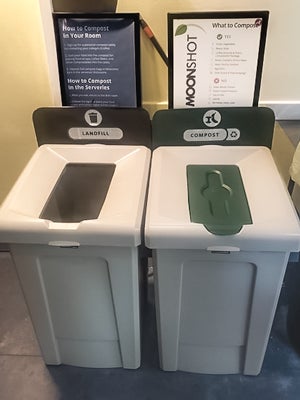
The program, which began in November 2020, is powered by student leadership and supported by Rice’s Campus Services and Sustainability. Moonshot provides the infrastructure and logistics, while student EcoReps and sustainability interns handle everything from bin placement and signage to data tracking and campus outreach.
“This program succeeds because students have taken ownership of it from the beginning,” says Kristianna Bowles, associate director for sustainability. “Their leadership has helped make composting visible, accessible and part of daily campus life.”
That’s no small thing. Food makes up about a quarter of landfill waste, where scraps buried without oxygen produce methane, a potent greenhouse gas. Composting offers a decidedly better outcome: Yesterday’s lunch becomes tomorrow’s healthier soil.
But the best waste is the waste that never happens in the first place. Metafoodx, an AI-powered system that scans leftover trays from the serving lines to estimate how much food remains, started at Seibel Servery and is now in the South Main Servery. Piloted by Housing and Dining, the data the system collects helps dining staff fine-tune batch cooking, preparing more of what students eat and less of what might end up as leftovers.
Students can get in on the experiment, too. A front-of-house scanner lets diners scan their plates after eating and before scraping any remains into the compost bin, offering another window into what — and how much — gets left behind. Rice is now exploring how to expand the technology to all campus serveries this fall.
The initiative is part of the Rice Living Lab Program, which turns the campus itself into a testing ground for sustainability research, education and innovation. Students aren’t just learning about environmental challenges in the classroom; they’re helping solve them between classes — one banana peel at a time.
From the Fall 2026 issue of Rice Magazine